March has arrived (well, it’s been here and I’m a little late) and I’m excited to announce that my first literary work, the lucky ones, will be published this month!
I’ll be sharing an excerpt of the (very) short piece later this month.
I’ve also been asked to read it at the journal’s launch party!
Thank you SO much for all of your support. Most of my online work is adoption-related, but my true passion lies for creative non-fiction.
Love you all and keep reading and sharing. Without you, I wouldn’t be able to push forward.
Adoptees are constantly searching for meaning, greedily looking for validation, for someone or something to provide insight into their lifelong condition that remains hidden by misconceptions and deceptions. Seeking solace in each other’s communities, then, offers a respite from the constant ache.
It’s understandable. Even still, I firmly embrace the perspective of non-adoptees, as these people—far be they removed from our situation—occasionally overturn my own prejudices and keep me out of the adoption fishbowl.
I’ve also found a slightly bleak pattern in adoption writing. Despite our best intentions, the collective weight of our voices echoes mostly among ourselves. Some of our words carry, but many of them remain shared between each other and don’t reach the audiences who really need to hear us.
It’s for this reason that, starting this week, I’ll be periodically reviewing books that touch on life’s perplexing relationship with loss, touching upon grievously bare nerves. I’ll weave into the book’s review the association with adoption’s pain, showing others that our suffering is universal. If we—adopted or not—identify with those feelings, we’re one step closer to convincing others that our struggle is real.
Why books?
Books have always been my solace. Books, the consolation prize for a solitary life, are always there. I polish off a novel or non-fiction work every week or two and enjoy short stories and flash pieces on the daily.
I want to share this with you. I want for you to find a piece of literature that keeps you up at night and makes you better understand why key players in our lives enacted so many unintentional wrongs. The beauty of literature is its ability to speak to many people in different ways, at any time of their lives.
For non-adoptees, I offer books as our olive branch, inviting each other to witness our inner battles. A truce, I suppose, of words.
Feel free to share this post or suggest your favorite books in the comments.
Part One introduced adoptees as perpetual children and their status as invisible minorites. Part Two focuses on adoption insults and the American family.
We might wonder how we arrived here, with so many adoptees divided on the subject of their birth and subsequent adoptions. We’ve established that inevitable myths and maybes are associated with adoptions of all kinds (intercountry, transracial, domestic, etc.), creating chasms among diverse sets of adoptees, but what else created society’s invisible minority?
Two ongoing external factors keep adoptees in a childlike stasis: One, the continued abuse of the phrase “You’re adopted!” and two, misconceptions of the traditional American family.
Let’s go back in time by briefly recapping American family history, starting with the 1950s—the time when adoption (especially intercountry/transracial adoption) became more common. Then we’ll look at the media’s use of adoption as an insult and tie the themes together to understand adoptees’ current condition.
Remember, this article only briefly summarizes a deeper conversation—my work-in-progress dives further into the literature and its greater impact on adoption. For simplicity’s sake, I’m focusing on the period between 1950 and 1980.
Be sure to follow me for more sneak peeks!
Leaving “Leave it to Beaver” Behind
Children of the 1980s watched reruns of “Happy Days,” “Leave it to Beaver,” and “The Donna Reed Show,” often alongside parents for whom these programs elicited nostalgia for the good old days. Dads knew best, making fathers all-knowing beings who created and supported progeny with guaranteed good futures. Moms were usually smiling dress-wearing chefs.
Younger generations criticize these whitewashed shows, mocking the racially and gender-role limited representation of the all-American household. But popular culture is a pervasive creature, weaving its way into fading memories and creating reality out of potentially unhappy fictions. What we end up with is a pervasive idea that families must match and anything else—especially a white family with a non-white addition—symbolizes failure or distrust.
Adoptive parents raised in the 1950s absorbed a culture that newly encouraged “men as well as women…to root their identity and self-image in familial and parental roles.” What with Cold Wars and World Wars, an emerging middle-class of white Americans were ready to embrace their latest post-War economic gains and make the nuclear family “the most salient symbol and immediate beneficiary of their newfound prosperity.”
These financial freedoms weren’t available to non-Whites, but that’s no matter: The rising racial divides and battles for equal minority representation were mostly hidden from families nestled in homes behind white-picket fences and cul-de-sacs. As a result, the ideal family was neighborly, homogenous, and conformist.
Today, it’s easy to see the consequences of such self-imposed sheltering, but how did it impact adoption?
Adoption: the Ultimate Non-Conformity
At the same time monoracial middle-class family units prospered, Korean adoptees—brought to the United States beginning in the 1940s and continuing en masse through the 1980s—matured alongside this budding American dream. Their existence, along with black adoptees (adopted less frequently than Koreans), was set against a backdrop of sameness. But transracial adoptees represented to liberals a social progression; proponents for racial equality could point to transracial adoption and proclaim that we’ve achieved success.
But for others, adoption may have been a blight on American achievements. Since non-white persons still retained “other” status, their unmistakable presence among their adoptive families may have led outsiders to question the stability of the so-called traditional American family.
And, despite the 1960s and 1970s notable progressiveness, adoptees whose appearance differed from their families remained polarizing symbols: either progressives were doing something right or they took equality too far. For adoptees who matched, their existences became a sometimes shameful secret—what damage could an unwanted child bring to a family?
The Adoption Insult
With the nuclear family tantamount to success, adoptees symbolized failure: Someone failed to care for these “orphans,” someone failed to take advantage of the economic prosperity available to middle-class Americans, someone failed to adhere to the country’s still-pervasive Christian values.
It’s then that adoption became an insult since adoptees represented an affront to “proper” society. On one hand, optimistic people viewed it as another American achievement; we can afford to take care of others as well as ourselves. But ultimately, less-informed or more traditional folk may have viewed it as a serious decline of moral values.
[T]he family has somehow become less important. Well, I can’t help thinking just the opposite: that when so much around us is whispering the little lie that we should live only for the moment and for ourselves, it’s more important than ever for our families to affirm an older and more lasting set of values.
In Reagan’s conclusion, he wistfully noted that “there is a certain quietness, a certain calm: the calm of one still night long ago and of a family—father, mother, and newborn child,” leaving very little room for adoptees and plenty of space for stubborn adherence to so-called societal norms.
With so much optimistic fervor surrounding family traditions, it logically follows that “Mom and Dad don’t really love you—you’re adopted!” and “Don’t mind Johnny’s taste for eating paper plates; he’s adopted!” would result.
Unfortunately, Hollywood love(s) this trope, prominently featuring it in 1990’s Problem Child, where even considering adopting a troubled child creates a black mark in an entire neighborhood. (Not to mention the “He’s not even a real kid. He’s adopted!” quip.) The implication seems to be that orphans are dangerous cat-throwing pyromaniacs who worship prisoners in the guise of Michael Richards. And the overarching sentiment lies solely with his poor, well-meaning parents–Junior’s issues are only barely acknowledged.
This movie—and countless other media representations—made adoption a punch line, a stigmatizing condition that’s either all good or all bad. And despite the rise of charities supporting children’s needs, it was best to philanthropize at a distance; inviting stranger children into our homes overstepped boundaries, highlighting unsolvable societal problems.
*
Maybe my definition of adoptees as invisible minorities needs a revision. Adoptees may be more accurately described as “society’s shameful open secret,” especially when leaders declare that “in recent decades the American family has come under virtual attack.” Donald Trump’s recent State of the Union address also perpetuated adoption misconceptions, firmly entrenching adoptees in a state of inertia.
*
Part Three will conclude this series, wrapping up with discussion of adoptees’ current efforts to undo these misconceptions. I’ll disuss the challenges they face, as well as what else must be done if adoptees are to change adoption’s public perception.
The mismatch in expectations versus reality for adoptees and non-adoptees is obvious. To expand adoption’s relevancy, this ongoing longform series provides a high-level view of adoptees’ current perspectives. I’ll attempt to uncover why adoptee writing stays relegated to niche groups or newsletters; why adoptee mistreatment and abuse makes ripples only amongst those affected; and what we can do to simply care. By moving away from adoptee-as-child terminology and welcoming non-adoptees into the conversation, we can begin taking their experiences seriously.
There exists a group of people, foreigners within their own families, who form kinship from strangers’ blood. Adopted as babies and children and teens, they mature into adulthood yet remain forever frozen as society’s adopted children.
It doesn’t matter how assimilated adoptees become, into their new families or into new cultures if immigrating from another country. For some reason, they’re referred to — even by government representatives — as children. Adults adopted as a result of wartime conflicts, like Amerasians of the Korean War or the Vietnamese left behind after that war, have clearly aged into adults. Many, like Lynelle Long, become activists who meet with country officials to voice their concerns with the practice. Despite their accomplishments, though, they’re still viewed as the children sent away.
Why are we categorizing a subset of our adult population this way?
Adoptees have known two mothers, two lives, and migrated within two worlds, sometimes jarred violently from a womb to a stranger’s waiting arms. Adoptees survive this and develop into mostly capable adults, but then have their frequently traumatic experiences buried under childlike descriptions.
There is a reason for this stasis.
Society still devours happy endings. Adoptees are the ultimate humanitarian symbol: Presumably unwanted, a willing family took a child in and savedthem, imbuing an aura of childlike wonder around them. Refugees and orphans become a parent’s act of charity and love. What could be better than that?
But admitting the adopted child grows up means acknowledging that we may have objectified a human being. To remedy the mistake, adoptee experiences that don’t align with our expectations are discredited.
It’s time to #JustListen.
The Curious Phenomenon
Ending the story once an adoption’s finalized creates a curious phenomenon: We tune out the object of fascination, hearing from them only what validates our values.
In an era where hasty generalizations are eschewed, the population most impacted by adoption — adoptees — remains largely overlooked.
#BeingAdoptedMeans your voice (even as an adult) is rarely valued with the same weight as an adoptive parent's opinion. #adoptee
Some adoptive parents make cutesy videos about their adoption announcements, garnering thousands of views, shares, and outpourings of financial and emotional support. (Note: I do not support that video. At all.)
Once the object — the child — is obtained, the story ends. At least for the adoptee.
The parent’s journey continues. Their struggles raising a child with predictable attachment and other behavioral issues become the parent’s burden, not the child’s. Here the parents are at an advantage, getting to tell their story before the child has the vocabulary necessary to speak out.
The adoptee doesn’t get the opportunity to speak, at least not until they’re older, when their disgruntled blogs and tweets and Facebook statuses are overshadowed by their parent’s love and selfless devotion. By then, the child has become trapped in a sort of suspended animation; always adopted, yet expected to accept — without question — their circumstances.
Yet — and here’s where it’s really curious — many kids, especially adolescents, experience turbulent, ragey years. As a natural reaction to the dichotomy of budding independence yet still dependent upon parental financial and emotional support, teens rebel. But adoptees, already hampered by origin issues and (for transracial adoptees) racial identity confusion, act out even stronger, filtering frustration from a place more primal than simple teenage rebellion.
They’re expressing grief. Deep, traumatic grief, couched in abandonment issues that manifest themselves as relationship difficulties, drug or alcohol abuse, or — in some cases — suicide.
And even so, reports focus on how much the parents struggled with the child’s behavior, how much effort was wasted on someone who was selfishly unreceptive to love.
It is a disservice to an adoptee if you believe that their accomplishments are due to the "good parenting," they’ve received and anything “bad” is because they’re adopted.
This is what #BeingAdoptedMeans to me and how those ignorant on the matter have come to label me.
When any child has serious troubles, it’s a tragedy for that child and the family. When the adopted child has problems, it’s personal. It’s a direct insult and a bitter truth: Love isn’t always enough. That truth manifests as resentment on a parent’s and greater society’s behalf; after all, if a practice so rooted in love and selflessness could be so easily dismissed by the “saved,” it’s easier to blame the victim than address the problem’s roots.
The Invisible Minority
There’s another reason we need to pay attention to adoptee voices.
Adoptees are the ones with first-hand experience in a system that took away their control, but no one seems to hear what they’re trying to say.
They live and work alongside you, but you’d never know their secret. They’re part of a population with life stories that began with true uncertainty and unwant. They encompass all races and hail from a plethora of countries.
They began their lives with loss and gains, asked for and about but never just asked.
Still, adoption remains an uncomfortable topic for some, an insult for others, or, in its extreme, a divine act proposed by God. Even as adoptee activists write strongly-worded missives against the practice, create catchy hashtags (#BeingAdoptedMeans and #JustListen are the popular ones), and maintain well-trafficked blogs, they only garner mass attention when something ugly happens.
Take, for instance, the South Korean adoptee who was deported then committed suicide in his “home” country. Or the recent article about the three-year-old girl murdered by her adoptive parents. Obviously these incidents belie any happy ending, though some are still inclined to believe these are one-offs in a largely beneficial system.
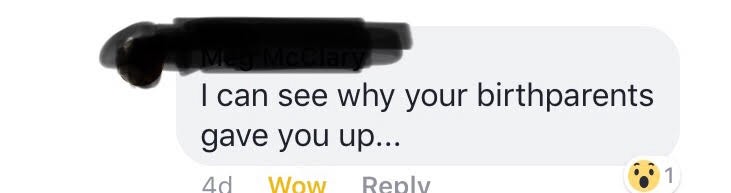
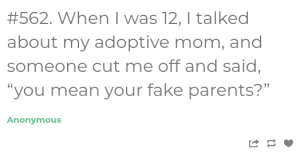
When adoptees speak out about the practice — mind you, they’re not doing it as a reactionary measure but in addition to these tragic events — they’re ignored or challenged:
This was actually said by an adoptee to another adoptee — the cannibalism is real.
If this were any other group clamoring for attention, I believe they’d be much more successful. Instead, it remains easier to cling to myths and maybes about a practice than systematically change our opinions. And when adoptee protests are drowned out by kitchsy videos and GoFundMe requests by prospective adoptive parents, adoptees are seen as ungrateful bitter jerks.
With minority status, perhaps their activism will be taken more seriously; rather than being viewed as ungratefuls rebelling against their saint-like parents, they’ll hopefully emerge into mainstream conversations as a marginalized group long misunderstood by stereotypes and stigmas.
Curiouser and curiouser.
Facing Forward
As families change shape and form, as reproductive technologies and the definitions of motherhood and fatherhood blur, adoptees cannot and should not be overlooked in these discussions.
After all, adoptees asserted their space in a society that still prioritizes biological relations. Adoptees, perhaps, are society’s pariahs. They don’t deserve that status. Adoptees were among the first to rewrite our country’s perception of the traditional family, yet are assigned passive roles. It’s the notion of the adopted child that keeps them ignored.
Part Two of this series will look at America’s role in creating adoption insults and America’s historical relationship with the traditional family.
Feel free to follow me so you don’t miss the next update!
Like this? Want more? So do I! Find out about my upcoming ventures on my Patreon page!
Adoptees talk about birth moms and adoptive moms and make up clever names like “first moms.” Some of the angry ones call them worst moms.
But we don’t talk about what happens when adoptees become moms. What do we call them?
Our children call us Mommy or Momma or Mom, but I just call myself Lost.
I relate the following as my example of an adoptee’s complex relationship with motherhood, an already challenging position. I encourage adoptees to share their stories so others realize how our inauspicious beginnings follow us to parenthood.
My mother died when I was twenty-five. She endured three anxious years of surgeries and blood tests while I watched the only mother I’d ever known slowly leave me.
Wait–that’s not right. I knew another mother, but only for two-and-a-half months. And then we parted ways. When I sought her out, I discovered she died less than ten years post-me.
So I’m again mom-less, raising a son with only memories for guidance. Like any mother, I’m doing the best I can. But there’s a difference:
I envy my son.
I envy my son because at three years old he knows something I don’t–the privilege of having a consistent caregiver, one who never questioned his existence. He carelessly plays his days away, taking for granted a woman who spirits pretzels and juice and raisins to his side, knowing no different.
Apologies, but the piece I adapted this section for HAS BEEN SELECTED FOR PUBLICATION! I will link to this story once it goes live, but the overall message here will stay 🙂
For adoptees, parenting is a declaration: We survived. We carry traumas from our abandonments, yet we’re using them to make us stronger parents. Simply being present means we’ve done more for ourselves and our children than was ever done for us.
Adoptees are rewriting adoption’s definition. The literature rarely looks at adoptees as parents, making our insights invaluable to the practice. Let’s start sharing now and give them something to talk about.
Be a part of the future! If you’re interested in sharing your adoptee-turned-parent story, feel free to contact me. I’ll use our stories to weave together a long-form article on adoptee parents. Thanks!
Like this? Want more? So do I! Find out about my upcoming ventures on my Patreon page!
Hey all! As if you couldn’t get enough of me, I’m publishing over at Medium in addition to maintaining blog posts here. Those articles are a bit different than on this site so I hope you enjoy them.
As always, feel free to share and comment. I always love your feedback.
I am not a political person but recent events have forced my commentary on an astoundingly racist comment by – as I’m sure you know – President Donald Trump.
When I set out to write my book, I sought to uncover why an adoptive father with deeply prejudiced views would consider transracial adoption. I’m analyzing three distinct but intertwined histories: the American family, America’s anti-Asian sentiment, and, of course, the history of transracial adoption, all in an effort to explain otherwise inexplicable behavior.
But I never imagined that my country’s leader, a man describing predominantly poor and black nations as “shit holes,” would hasten my path to an answer.
And here it is:
Trump’s language is identical to my father’s, a man who’d use similar rhetoric to describe those same countries. And that superiority complex, I now realize, is what drives certain white men to determine who’s good enough to come to this country and live among their families, and who has to stay out.
Woeful bigots who transracially adopt might have complex motives rooted in what I continue to uncover, but never has an answer to a deeply complex question been presented to me with such appalling clarity. If racism trickles down from the top, then we have an even more complicated issue to address: How do we protect ourselves against forces so powerful and how can we prevent this from happening again?
For one, we cannot allow ignorant white men’s opinions to pit minorities against each other. It’s a vicious attempt to assign racial hierarchies among human beings. We need to view their commentary through a lens of insecurity and inferiority, the basic root of all immigrant-directed nativistic racism.
I hope that Trump’s comments unite people of all colors against such despicable language. I also hope that this event provokes immigrants to loudly tell their stories, so that we may continue documenting the struggles we encounter every single day.
Thanks, all of my readers, for letting me veer off the path a bit :). You mean the world to me!
Like this? Want more? So do I! Find out about my upcoming ventures on my Patreon page!
Like many angsty teens, I wanted a chasm to open up and suck me in so I’d never have to face this cruel, cruel world anymore, but again, like many angsty teens, what I really wanted was as much attention as possible. I wanted someone to look at me and say “Yes, you are different and yes, you’re Asian. That’s cool. Now where’s that five dollars you owe me?”
What I received was the complete opposite. I heard “I see your face and it’s offensive and so freaking weird that it exists within your White family. Now let me ask you about it!” (These are calledintrusive interactions and they’re as awkward as they sound.)
But something slightly disturbing happened whenever I’d complain about these unwanted behaviors; I’d be accused of imagining things, of being overly sensitive, of not humoring other people’s curiosity. Worse yet, I’d be told that it was something else about me, some indescribable flaw that made me a target. Evidently, “I’m going to kick your eyes straight!” and “Go back to your own country” have nothing to do with my appearance.
Eventually, my mother would tell me I dreamt these things up and that if they really were happening, I should just stop drawing so much attention to myself (leading me to pen a piece calledShut Up and Smile, in response to misplaced blame).
Her reaction – and society’s as a whole – to subtle forms of racism (aka racial microaggressions) is a quietly dangerous one, serving only to perpetuate the cycle of victim-blaming. The below video is an entertainingly informative few minutes of Derald Wing Sue’s definition of racial microaggressions, but the YouTube comments are perhaps the most telling status of America’s view of race.
I’ll save you the pain of reading through the comments; like everything on the internet, they’re filled with hate and racism and spew forth rage, accusing the professor of imagining things that aren’t really there, telling minorities to grow a thicker skin.
For the transracial adoptee, we need to be particularly sensitive to how racism is handled by both ourselves and our families. While finding racism where it doesn’t exist isn’t helpful for anyone, transracial families should accept that overt acts of hate, like shouting slurs or getting beat up, exist alongside more slippery ones that evade quantification.
But there’s a solution. All forms of racism, such as colorblindness and hopeless commentary like this:
Person For Whom The System Was Made To Benefit Recommends We Stop Criticizing The System pic.twitter.com/XRoXb6pLQT
need to be considered, addressed, and handled. Directly. Be the awesome White parent who acknowledges your child’s race without the dreaded whitewash.
Vagaries like “hate for hate’s sake is bad” can be more effective if discussions include specific topics like White privilege and the history of the child’s ethnic group in this country. Admit to the color gap between you and your child; this isn’t an act of mercy or sacrifice or guilt-tripping, but one of empowerment for the future adult you are raising. Doing so will firmly cement your child in a position of security, because her status as a person of color will not be denied.
Celebrating color is not enough – we must concede that White parents and their transracial children will live vastly different lives based solely on race; we must embrace this truth as a starting point for weaving our developing values together. By starting this journey at home, parents have tremendous potential to positively influence their child’s racial identity.
Like this? Want more? So do I! Find out about my upcoming ventures on my Patreon page!
Today’s article is inspired by a Facebook post in one of my Korean adoptees’ groups, speaking closely to several topics in my work-in-progress. How do we measure Asian attractiveness; or, how do we measure any person of color’s attractiveness?
His post highlights an unfortunately prevalent beauty standard where White/Caucasian is the ring for which POC should reach. The article showed a bevy of gorgeous faces, Eastern in origin but with one key characteristic: They’re Asian, but not too Asian.
The Facebook user provided this (unedited) commentary:
You would never see a Chinese person on this list with a wide nose or a Filipino with dark skin. And if they do feature dark-skinned POC they always have to have thin AF noses and seafoam green eyes. They only praise us when we resemble the beauty of white people.
Gorgeous, but not too Asian.
This is indeed why eyelid surgery and nose jobs are so popular in Asia and it’s exactly the reason I grew up hating my own appearance.
In my case, as I’m sure is the case in many other adoptees’ experiences, I grew up studying my family’s Whiteness, analyzing my mother’s blonde hair, large blue eyes, and her long, straight Caucasian nose. I clung hopelessly to my father and brother’s dark hair and dark eyes, convincing myself that we shared similar features and thus I could pass as them – White.
While the less enlightened of us (or more generously, the optimists) might counter with “You should love yourself the way you are!”, let’s examine that sentiment.
Loving your appearance requires that our internal and external expectations for our image must match; for example, I was raised in a very anti-POC community with White-dominant values. Anything else was ugly, scary, or unacceptable. My flat face and watermelon eyes became immediate targets for haters, offensive enough to provoke spiteful commentary by classmates. At some point, my parents even rejected interracial relationships (Black/White), while their Asian daughter dated only Whites.
The ultimate message: Asian is bad, your face is worse. For many years – and even up until this point – I despised having my photo taken in profile; it only enhanced my face’s flatness, drawing a thick line between myself and the pristine profile shots of White-girl models in glossy teen magazines. At one point, my mother suggested a nose job once I got older, informing me that I lack a bridge, a feature fixable via plastic surgery.
Later, the Internet led me to articles on ethnic plastic surgery, a medical phenomenon brought on by both a wealth of disposable income and a plethora of Western values. When I shared this tidbit with friends and family, they were rightly horrified but the depth of their reactions tempered by their lack of lived experience within a non-White body.
Through my research and my chats with others, I’ve inferred that being raised in an ethnically diverse community makes a significant difference, and I would agree only based on my current adult experience. No one bats an eye at my mixed family or son when we go to the Asian food market or walk the streets of Philadelphia; this isn’t saying that our appearances don’t raise eyebrows for some – I’m not naïve – but the likelihood of us eliciting some type of exotic wow response by the majority of acquaintances is much lower.
One of the most humiliating experiences I ever had – well, one of the top ten anyway – was when my mom took me to the make-up counter in our local mall. Keep in mind that I lived in a White non-diversified area, where Italian was considered foreign cuisine. She intended to get me a prom-makeover. The counter girl undoubtedly lacked experience applying eyeliner, eyeshadow, and foundation to an Asian palette; without double eyelids and with yellow-toned skin, I came away looking like I got punched in the eye and subsequently spent a week recovering in the hospital.
I finally understood how vastly my face differed from those around me and required care unique to my race – something that would have been taught to be if I’d been adopted in-race. Similarly, my hair confounded my mom’s (White) hairdressers. No matter how much they razored, sheared, and thinned my coarse hair, it just wouldn’t fall into the ’90s Jennifer Aniston layers of the day. I lived through two perms in an effort to achieve that turn-of-the-century crunchy-haired look (failing, obviously), again deluding myself that I was this close while most likely fooling no one around me.
I understand the complexities though. It’s become impossible to admire someone of color without being accused of fetishization or holding the non-White up on some strange exotic pedestal. In my experience, I remember being told by the last remnants of Korean War vets that we were all “beautiful, beautiful people,” making me wonder if even the ugly ones of us were beautiful, or if our strangeness made us attractive.
Perhaps it was also just my unfortunate experience, but I’ll relate this unflattering anecdote for educational purposes only:
I wanted to wear the thick-framed, black-rimmed hipster glasses for the same reason every other early twenty-something did; it was fashionable and obvi expressed my edginess, like come on. My mom was anti-dork glasses for whatever reason, but after pleading with me to get rid of them, she finally dropped this one: They make your face look flatter.
Not only did I not stop wearing them after that, but I filed her words away into the forefront of my mind, the place where painful memories swish around, reminding you to keep your defenses up. Using racialized facial features to discourage following a fashion trend is ineffective, small-minded, and racist. I’d presume it’s also an occurrence that POC regularly confront, adoptees possibly more.
For transracial adoptees especially, we need to find support – outside of our families – to help develop positive self-image and racial appreciation; no one wants their child to be a self-hating anything, so transracial parents require awareness of not just their child’s larger culture, but their child’s unique needs with regards to self-care and facial features. Transracial parents should be prepared to adjust trends according to their child’s needs; this isn’t racist, it’s prudent. Just as a White parent of a Black child would learn hair care and other nuances, parents of Asian children and others require similar education.
But I know there’s more to changing the beauty narrative than simply figuring out how to apply makeup or cut hair. It’s a larger issue that’s finally being addressed by increasing numbers of POC – particularly Asians – in mass media, which will help normalize their appearance and provide guidance that a parent cannot.
Transracial adoptees and their parents are in a powerful position: We live within the minority and majority, making us privy to subtletities others miss. We can use this knowledge to spur progress in so many ways, including that of beauty standards.
I acknowledge I’m writing from a purely Americanized viewpoint, but I welcome your thoughts on this topic and I’d love to hear your encounters with this unfortunate byproduct of Western society!
Like this? Want more? So do I! Find out about my upcoming ventures on my Patreon page!
I’ll admit it: My work is an unapologetic retrospective dissection of transracial adoption’s history from the 1950s up until my 1980s debut, with a strong tendency toward dwelling on the past to justify the present. I recognize the danger in doing this; I may be stuck gazing into the looking-glass while real progress blows by, making my viewpoints obsolete and discrediting the industry’s great strides.
Today I’d like to spend some time discussing how my experiences – and many others – shaped transracial adoption’s current landscape. Although my history may have been traumatic, I know that they weren’t all for naught.
However, this doesn’t mean there isn’t still work to do. Younger generations of transracial adoptees (TRAds) and their parents (TRAps) may have access to more resources than their forebears (Facebook, Families with Children from China, etc., are awesome), but it’s crucial to acknowledge the rocky path that brought them together.
In one way, this new generation of TRAds enjoys the United States’ overall improved racial awareness. What was acceptable several decades ago (Long Duck Dong’s character in Sixteen Candles, for example) would never fly today.
Yeah, not okay.
They’re living during an era of same-sex marriages, same-sex parenting, single parenting, and stay-at-home dads (which aren’t without their own sets of controversies but are a huge improvement over the past). Thirty-plus years ago, none of this was openly discussed.
An adoptee’s inherent losses aren’t diminished, though; grief is adoption’s timeless quality. But the awareness of and the support for this grief marks the distinct contrast between TRAds now and TRAds then.
A conversation with a friend and TRAp of a South Korean boy reveals the differences between our experiences. Her adoption agency encouraged interactions with her son’s foster parents and even promoted writing a letter to the orphanage in case the birth family ever comes searching. This is in direct contrast to the proxy adoptions touted by the same agency in the eighties, when adopting didn’t require a country visit and were completely closed.
Also, homeland visits are encouraged by both agencies and parents and have become a right of passage for many adoptees. Since the overall income bracket of TRAds and TRAps has gone up since the eighties, such trips may be a reality – unlike for me, where it was described as a distant dream.
Based on my friend’s reports, modern TRAps realize the importance of emphasizing culture, versus back in my day when colorblindness was key. Again, this is a move in the right direction, but she pointed out that most of the activities are fairly superficial (as I proposed on ICAV’s site), like celebrating holidays or eating a child’s ethnic food. Still, this is more than what I received – I never even used chopsticks until I was a sophomore in college.
What’s important to remember – and from which I won’t waver – is that it wasn’t always this way. Early adoptees are struggling with the wounds left by a societal experiment gone awry; only now are we seeing the damage it inflicted. Not only that, but we must acknowledge that in transracial adoption, there will be a permanent racial gap between parents and adoptees, requiring a lifetime of sensitivity and compassion to keep from widening.
The beauty, though, is that we have the power to shape the system. We did an early tour of duty through a country that didn’t know how to handle us, yet we persisted; now we are qualified to speak about our experiences for the benefit of those who come after us.
So ironically, maybe those who called us lucky were right. We are lucky because our suffering has turned our lives into stories for change. Our loving but sometimes unprepared parents forced us to forge our own paths, to confront head-on the racism and disconnect we’d forever feel as outsiders; but we don’t have to dwell on this, to ruminate on it as the fate of our lives. We are the agents who can help rewrite society’s concept of family.
Like this? Want more? So do I! Find out about my upcoming ventures on my Patreon page!








 a critical discourse.