blog posts

don’t stop believing, adoption activist friends

IMG-4332.JPG

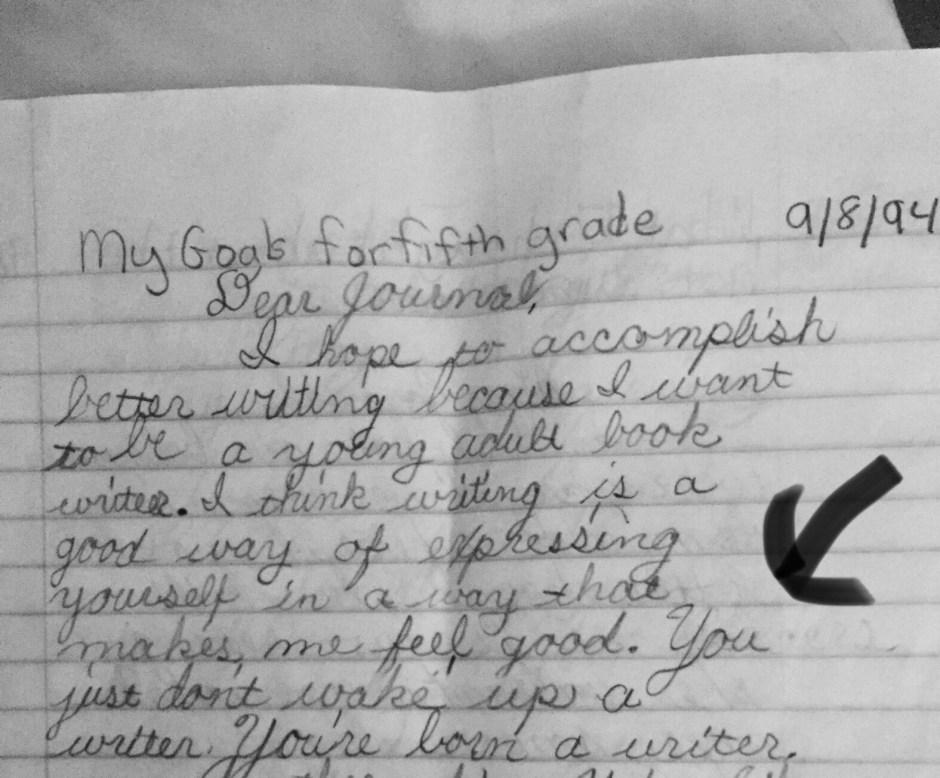
“I hope to accomplish better writing because I want to be a young adult book writer. I think writing is a good way of expressing yourself in a way that makes me feel good. You don’t wake up a writer. You’re born a writer.”

I found this the other day, buried and forgotten with an assortment of other journals I’ve kept. The hilarity and coincidences life throws us are so bizarre they seem contrived. And yet, here we are. The lesson? Don’t EVER give up and don’t let people discourage you, ever. Especially with writing, where sometimes the rigors of high school suck the fun out of the creative craft. Let your passions rest sometimes, but don’t forget from where they came.

Fifth-grade me would be proud, I think.  I’m not into the young adult genre–the youthful mindset’s long been scared out of me–but hey, after decades of meandering, I stayed true to the path.

Thanks for sharing this journey with me!

what my first launch party taught me about adoption writing

Hello, adoption activists: We’re begging the non-adoption community to #JustListen, but I think they might be hearing us.

tilde launch party.jpg
Thank you, Tilde: A Literary Magazine and The Spiral Bookcase!

Before reading “the lucky ones,” I introduced myself as what others would consider an adoption activist, but I told the crowd that I just call myself a writer. I explained that adoptees are desparate to be heard, but we’re speaking to a crowd already familiar with our struggle.

But art, I said, is a great unifier.

Through “the lucky ones” and other pieces I hope to release (including the upcoming “playground ghost,” due out next month by Parhelion Literary Magazine), I present, in what’s intended to be a relatable way, our pain and loss and longing. All of those heartaches are easily identifiable by anyone, adopted or not,  who circulates among us throughout this sometimes-wretched hive. But by weaving the subject within words recognizable by any human who experienced abandonment, people will, I think, find themselves behind the same mask adoption activists wear and understand our small niche’s large undertaking.

I encourage you to use whatever skills or talents you have to keep pushing for an audience. Knit hats for struggling young mothers, donate diapers to women’s shelters, create pottery for baby mementos–it doesn’t matter. Our art will resonate with the greater community–just speak to them and they will listen.

It will happen–we won’t give up.

A special thank you to Frank and Stephanie and Reshma and Lynelle and Rochelle and Marcie and Suzan and Lana and Adam and Liz and countless others who have helped get my work off the ground. Much appreciated!

announcement: first literary publication launched today! read it here.

I’m thrilled to share that my first literary piece, “the lucky ones” is now live in Tilde: A Literary Journal’s inaugral issue! I’m proud to see my work featured alongside some incredibly powerful poetry and prose.

Read it here: Tilde: A Literary Journal Tilde: A Literary Journal
And order a print copy here (support indie presses!):  Thirty West Publishing

cover

Excerpt:

In the time it took my mother to let me go, summer never changed to fall. Less than two months after her heart beat for mine, I became her living ghost.

We floated in parallel worlds, sharing blood, sharing tissue, the space between us widening with each infant’s longing wail.  For nine months I heard her whispers and felt her lies, love, and tears. And then she left me.

For six months after her face dissolved into a foggy memory, I was no one’s daughter. I was someone’s lament, someone’s case number, a stranger’s hope. But for a few brief moments in my frenetic early life, I lurked in a shadowy limbo where unwanted children go to wait.


Tonight is the launch party and yours truly is a featured reader. Thank you for ALL of your support and I can’t wait to keep growing with you!tildereleasepartyad

it’s a matter of perspective

The internet is up in collectively confused arms (do we increase our tissue box supply or dust off our pickets?) over this latest factoid:

plummeted
Tear-faced children: The perfect antidote to critical thinking.

On the one hand, proponents for adoption reform or cessation are thrilled. On the other, adoption supporters or those who just don’t understand why adoptees are skeptical about such a seemingly heart-wrenching newsbite should then read the troubling responses like this:

There are a few errors here, but the assumptions (and rhetoric) stated above routinely plague adoption activists and hold us back. Let’s break it down:

  1. “the cost”
    • Implies financial barriers prohibit “getting” a baby, as though a baby was an inanimate object or another status symbol; commodifies a human being
  2. “3rd world places”
    • Ethnocentrism implying undeveloped countries can’t care for their own
    • Partially racist
    • Outdated terminology (very telling)
  3. “[give] Americans their unwanted”
    • WHAT.
    • Reinforces the idea that adoptees began life as truly unwanted, partially upholding the “perpetual child” myth
    • Does not support in-country social services or family support
    • Ethnocentrism, and like there isn’t an adoptee issue here in America?

We MUST continue dispelling the myths surrounding adoption. From an adoptee perspective, this is a huge sign that we have miles to go before people understand the damage done by adoption. What’s worse is that attitudes demonstrated above discourage support for struggling mothers and fathers, framing adoption as the only ethical solution to their temporary problems.

As long as dialogue like this continues, control will steadily be wrested from families, as they remain convinced they cannot or should not seek help from their own governments. Shipping children out to the U.S. is not the answer.

Adoption, when it works as intended, can be wonderful. But supporting family preservation is an excellent solution as it empowers mothers, fathers, and children, rather than reducing them to desperation and lifelong trauma.

Like this? Want more? So do I! Find out about my upcoming ventures on my Patreon page!

the challenge in adoption writing

There’s a disturbing trend in adoption activism.

We all seem to write for each other, without hitting our ultimate goal: Reaching an apathetic public, a population whose interest ranges from “mildly disinterested” to “dangerously ill-informed.”

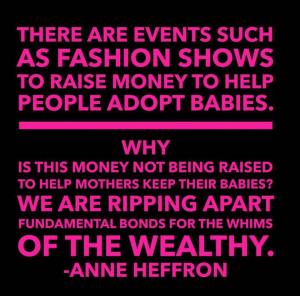
This isn’t surprising, given we’re up against issues like Anne Heffron’s points out below:heffron

It’s not surprising, but it is discouraging. Then we have another issue: rhetoric. Are adoptees orphans (no, most are not)? Can we call adoptive parents “adoptive parents,” and should we refer to birth mothers as “first mothers” or “natural mothers” or “biological mothers”? The adoption community debates these terms extensively, confusing ourselves and definitely confounding outsiders.

And then there’s the argument over who is allowed to discuss what. Can non-adoptees speak to the adoptee experience? Should adoptive parents have any say in their children’s lives? And are birth parents really the forgotten party in the adoption discussion?

Finally–and perhaps most damningly–there’s the Angry versus Happy Adoptee distinction, an informal label bandied around to stigmatize, invalidate, and attempt to win arguments. We’re scrambling to say something new, impactful, and purposeful, but activist’s messages get lost in the flurry to push out content.

Naturally, I speak only from the transracial adoptee perspective, since that’s my lived experience and the only one I feel qualified to discuss. But even then, there’s a tendency toward defensiveness, as though I still don’t possess the necessary skill set for maintaining my position.

None of this creates an environment inviting outside stakeholders to enact change. If we’re not united, it’s challenging for others to hear our cries. But adoptees know it’s near impossible for us to agree on a stance, but we concede that adoption is not a self-directed choice.

 So, as a thought experiment, I’d ask you to consider how hearing “I’m sorry you had such a negative experience” would feel if someone said that to you if you struggled with infertility before you adopted, or any of the other hard life experiences people live through that they had no control over.

Adoptees are the experts on being adopted.  Still, our lives are frequently illustrated by a partially informed public, or by those whose experience doesn’t align with our own.   Adoptees haven’t yet defined the line between objectifying ourselves and becoming consultants.

How do we use our voices as vehicles for meaningful change? Here’s my idea:

  • Temporarily set aside our anger and acknowledge that adopters and adoption agencies, like us, believe in their mission. People are more likely to listen to rational speakers.
  • Feature different adoption activists in our blogs, supporting each other even if we don’t 100% agree with a nuance in another’s view
  • Stop arguing about terminology amongst ourselves and focus on our real goals

I don’t suggest forgetting that certain terms are debatable or abandoning our passion projects. Our conversations absolutely have merit and will enact positive change. But we’ll likely never agree; adoption is too personal an issue for that to happen any time soon.

Instead, for now, I argue for coherency and collaboration. Idealistic, sure. Results-oriented? Absolutely.

Like this? Want more? So do I! Find out about my upcoming ventures on my Patreon page!

what getting a dog taught me about adoption

I am not a dog person. I am a “I like my dog” and a “I like about two other well-trained, non-odorous dogs” kind of person and I’m comfortable with my assessment. I’ve had 33 years to work out my preferences and I accept it.

IMG-1201

But in the throes of one of my worst depressions (a topic I rarely speak about online), I was faced with a choice: Continue down the dangerous path I was going and find myself somewhere terrible (again), or find a way to work through the detachment I felt to everyone around me.

As an adoptee-turned-mother, momming is a harrowing experience. I’m expected to return to my son a love I never knew, accepting his vulnerability and allowing him space to express it. But when an infant is abandoned, vulnerability becomes a death sentence–if you let your guard down, someone might never come back.

So in a fit of cautious desperation, I proclaimed that we should Get A Dog. And not just any dog: We’d get a Labrador Retriever, the kind famous for being service animals and police dogs and–most importantly–highly trainable.

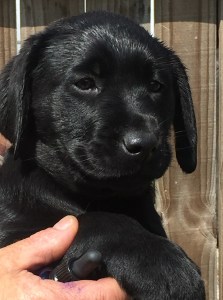
The expectation was this: Mindy (the Dog) would be a safe place for me to explore my adoption-related attachment issues, rather than allowing them to impact the relationship between me and my family.  Less than a month later, we had Mindy.

IMG-6240
circa February-March 2017

Dog ownership continues to have unexpected consequences, some good and some slightly confusing. However, the best part is Mindy gives me a chance to explore my attachment issues without judgment or deadlines.

Here’s what we discovered after Mindy arrived.

  1. The cats weren’t happy – I can’t make this list without mentioning them and I’m pretty sure they can read and exact timed vomitus maximus revenge all over my floor. So there.
  2. I’m a great dog trainer – I’m cheating a bit–Labs are eager students. But training her has given me a level of control (and a willing party) over my life, something I’ve always strived for and now find deeply satisfying. As an adoptee, our lives were determined by strangers. Now, I get to impact someone else’s life positively and see almost instant results, depending on the treat I’m holding.
  3. Vulnerability terrifies me – This is a side effect of my home life and adoption, one that many of you may experience. In weak moments, I see her eyes looking right through me, with a trust so blind and willingly offered it sparks a visceral reaction. It helped me uncover my own issues with adoption: If you were weak, you might be abandoned.  This placed me one step closer to understanding why I feel distant from my son.
  4. Neediness = Rejection – Along with #3, she needs me. L (my son) needs me. I never felt needed in any of my personal relationships, preferring instead to consider myself disposable. But to these beings, I’m someone. I’m important. And that’s horrifying. It’s easier to reject those seeking my love because adoption left voids where self-worth should have developed.
  5. I’m still not a social person – What is it about dogs that make people think you want to  chat?

Obviously I love Mindy but what I’ve uncovered are the walls I’ve built to keep myself safe. The beauty of her company is not just her role as a playmate to my son, but exposing where I’m holding back.  Until I’m able to address these issues–and I will–I’m unable to fully love those I care about the most.

Adoption, then, has taken something from me that requires extensive work to re-obtain. For many of us, adoption has taken our ability to form bonds and find safety even the homes we build after we’ve left our adoptive families.

But later, I found a poetic kind of parellel between us. She was readily left her mother and was taken from her 11 siblings without a whimper or a whine, entering my car and unquestioningly started a new life. I thought about her situation and realized how similar we were, with both of us brought into new homes and expected to just go with it.

Somehow, she fared better. She left her mother and siblings and will likely never see them again, yet accepted her situation and was already leading me home after our walks only a few days after her arrival. I, however, am left puzzled by her willingness to concede to her separation, choosing me as her Person and wanting nothing more than my company. Where I fight every attempt at inclusion, she willingly embraces it despite her losses.

I don’t understand her love and maybe I never will. But sometimes I wonder: Is it necessary?

It’s been an enlightening experience and seeing our future together and her impact on my life as I work through adoption issues is exciting. Thanks for letting me share this with you. I would love to know how pets are helping you through your adoption healing. Please share below :).

Like this? Want more? So do I! Find out about my upcoming ventures on my Patreon page!

march book discussion: Heft

heft
Liz Moore

Spoiler Alert: Unmarked spoilers ahead. Be warned.

I’ve always preferred literature about outsiders. Outsiders who, when caught in a grapple with internal and external forces designed for failure, establish with me a comforting little kinship. These characters usually follow the same type: Alone or cast aside with problems partially of their own making and partially born from disappointments bestowed by adults sworn to protect them.

Heft combines elements of mild self-loathing and isolation, a sneaky type of solitude that creeps along so slowly it bewilders even the narrators.  Unsure if it’s self-imposed or something else, Liz Moore skillfully reveals pieces of the main narrator’s life, making it uncertain if the 500-pound recluse is happy or a victim of his pain.

This uncertainty is a familiar mind state for many adoptees. Are we happy with our adoptions, or do we create false comforts, surrounding ourselves with objects (as does our main narrator, Arthur Opp) and eating until morbid obesity? What subconscious actions help us regain control over stolen lives?

Throughout the novel, Moore weaves a bit of a familial mystery into the threads of the characters’ histories. We are asked who parented one of the novel’s secondary characters—Kel Keller—a young man whose life was born of broken adults and bad choices. After his mother’s death, Kel frantically searches for his father, a man who disappeared early and was painted into life by his mother’s descriptions.

These stories, however, turn out to be false. Kel’s mother wanted to believe they were abandoned by a man greater than the sum of his disappointments. In the end, Kel finds someone less a father and more a disappointment. He also receives a letter–one that I will keep secret until you read it–providing advice many of us may have wished to receive.

Heft’s lesson is one from which we’d all benefit. Maybe it’s sometimes better never knowing the truth about our parentage, accepting that the people we want most are better left behind.

Why Heft is March 2018’s Adoptee Required Reading

Adoptees will find a reassuring comfort in Moore’s characters, relating perhaps too closely to the suffering of each of her brilliantly believable players. Everyone is searching for someone or something. If we find the it, we tell ourselves, we’ll be complete.

But sometimes answers are beyond our reach. And Moore’s Heft shows that, even in the absence of logical reasoning, we may find peace and build a life based on our decisions, no longer subjecting ourselves to others’ whims.

daniele-levis-pelusi-221717-unsplash

Discussion Time!

Have you read Heft or are you planning to add it to your to-be-read pile? Let me know in the comments or share your thoughts on Facebook!

If we generate enough interest, we can start an online book group, focusing specifically on works that contain themes on loss, family, and disconnect.

announcement: first published literary work!

leonard-von-bibra-182682-unsplash.jpg

Hello loyal readers!

March has arrived (well, it’s been here and I’m a little late) and I’m excited to announce that my first literary work, the lucky ones, will be published this month!

I’ll be sharing an excerpt of the (very) short piece later this month.

I’ve also been asked to read it at the journal’s launch party!

Thank you SO much for all of your support. Most of my online work is adoption-related, but my true passion lies for creative non-fiction.

Love you all and keep reading and sharing. Without you, I wouldn’t be able to push forward.

new column: book reviews!

natalie-collins-57861-unsplash.jpg

Adoptees are constantly searching for meaning, greedily looking for validation, for someone or something to provide insight into their lifelong condition that remains hidden by misconceptions and deceptions. Seeking solace in each other’s communities, then, offers a respite from the constant ache.

It’s understandable. Even still, I firmly embrace the perspective of non-adoptees, as these people—far be they removed from our situation—occasionally overturn my own prejudices and keep me out of the adoption fishbowl.

I’ve also found a slightly bleak pattern in adoption writing. Despite our best intentions, the collective weight of our voices echoes mostly among ourselves. Some of our words carry, but many of them remain shared between each other and don’t reach the audiences who really need to hear us.

It’s for this reason that, starting this week, I’ll be periodically reviewing books that touch on life’s perplexing relationship with loss, touching upon grievously bare nerves. I’ll weave into the book’s review the association with adoption’s pain, showing others that our suffering is universal. If we—adopted or not—identify with those feelings, we’re one step closer to convincing others that our struggle is real.

Why books?

Books have always been my solace. Books, the consolation prize for a solitary life, are always there. I polish off a novel or non-fiction work every week or two and enjoy short stories and flash pieces on the daily.

I want to share this with you. I want for you to find a piece of literature that keeps you up at night and makes you better understand why key players in our lives enacted so many unintentional wrongs.  The beauty of literature is its ability to speak to many people in different ways, at any time of their lives.

For non-adoptees, I offer books as our olive branch, inviting each other to witness our inner battles. A truce, I suppose, of words.

Feel free to share this post or suggest your favorite books in the comments.


Society’s Perpetual Children: An Introduction to the Adoptee Condition (Part Two)

Part One introduced adoptees as perpetual children and their status as invisible minorites. Part Two focuses on adoption insults and the American family.

We might wonder how we arrived here, with so many adoptees divided on the subject of their birth and subsequent adoptions. We’ve established that inevitable myths and maybes are associated with adoptions of all kinds (intercountry, transracial, domestic, etc.), creating chasms among diverse sets of adoptees, but what else created society’s invisible minority?

Two ongoing external factors keep adoptees in a childlike stasis: One, the continued abuse of the phrase “You’re adopted!” and two, misconceptions of the traditional American family.

Let’s go back in time by briefly recapping American family history, starting with the 1950s—the time when adoption (especially intercountry/transracial adoption) became more common. Then we’ll look at the media’s use of adoption as an insult and tie the themes together to understand adoptees’ current condition.

Remember, this article only briefly summarizes a deeper conversation—my work-in-progress dives further into the literature and its greater impact on adoption. For simplicity’s sake, I’m focusing on the period between 1950 and 1980.

Be sure to follow me for more sneak peeks!

Leaving “Leave it to Beaver” Behind

beavercatbag02

Children of the 1980s watched reruns of “Happy Days,” “Leave it to Beaver,” and “The Donna Reed Show,” often alongside parents for whom these programs elicited nostalgia for the good old days. Dads knew best, making fathers all-knowing beings who created and supported progeny with guaranteed good futures. Moms were usually smiling dress-wearing chefs.

Younger generations criticize these whitewashed shows, mocking the racially and gender-role limited representation of the all-American household. But popular culture is a pervasive creature, weaving its way into fading memories and creating reality out of potentially unhappy fictions. What we end up with is a pervasive idea that families must match and anything else—especially a white family with a non-white addition—symbolizes failure or distrust.

Adoptive parents raised in the 1950s absorbed a culture that newly encouraged “men as well as women…to root their identity and self-image in familial and parental roles.” What with Cold Wars and World Wars, an emerging middle-class of white Americans were ready to embrace their latest post-War economic gains and make the nuclear family “the most salient symbol and immediate beneficiary of their newfound prosperity.”

These financial freedoms weren’t available to non-Whites, but that’s no matter: The rising racial divides and battles for equal minority representation were mostly hidden from families nestled in homes behind white-picket fences and cul-de-sacs. As a result, the ideal family was neighborly, homogenous, and conformist.

Today, it’s easy to see the consequences of such self-imposed sheltering, but how did it impact adoption?

Adoption: the Ultimate Non-Conformity

tom-barrett-369215

At the same time monoracial middle-class family units prospered, Korean adoptees—brought to the United States beginning in the 1940s and continuing en masse through the 1980s—matured alongside this budding American dream. Their existence, along with black adoptees (adopted less frequently than Koreans), was set against a backdrop of sameness. But transracial adoptees represented to liberals a social progression; proponents for racial equality could point to transracial adoption and proclaim that we’ve achieved success.

But for others, adoption may have been a blight on American achievements. Since non-white persons still retained “other” status, their unmistakable presence among their adoptive families may have led outsiders to question the stability of the so-called traditional American family.

And, despite the 1960s and 1970s notable progressiveness, adoptees whose appearance differed from their families remained polarizing symbols: either progressives were doing something right or they took equality too far. For adoptees who matched, their existences became a sometimes shameful secret—what damage could an unwanted child bring to a family?

The Adoption Insult

austin-ban-14521

With the nuclear family tantamount to success, adoptees symbolized failure: Someone failed to care for these “orphans,” someone failed to take advantage of the economic prosperity available to middle-class Americans, someone failed to adhere to the country’s still-pervasive Christian values.

It’s then that adoption became an insult since adoptees represented an affront to “proper” society. On one hand, optimistic people viewed it as another American achievement; we can afford to take care of others as well as ourselves. But ultimately, less-informed or more traditional folk may have viewed it as a serious decline of moral values.

*

In the 1980s, Ronald Reagan declared

[T]he family has somehow become less important. Well, I can’t help thinking just the opposite: that when so much around us is whispering the little lie that we should live only for the moment and for ourselves, it’s more important than ever for our families to affirm an older and more lasting set of values.

In Reagan’s conclusion, he wistfully noted that “there is a certain quietness, a certain calm: the calm of one still night long ago and of a family—father, mother, and newborn child,” leaving very little room for adoptees and plenty of space for stubborn adherence to so-called societal norms.

With so much optimistic fervor surrounding family traditions, it logically follows that “Mom and Dad don’t really love you—you’re adopted!” and “Don’t mind Johnny’s taste for eating paper plates; he’s adopted!” would result.

Unfortunately, Hollywood love(s) this trope, prominently featuring it in 1990’s Problem Child, where even considering adopting a troubled child creates a black mark in an entire neighborhood. (Not to mention the “He’s not even a real kid. He’s adopted!” quip.) The implication seems to be that orphans are dangerous cat-throwing pyromaniacs who worship prisoners in the guise of Michael Richards. And the overarching sentiment lies solely with his poor, well-meaning parents–Junior’s issues are only barely acknowledged.

This movie—and countless other media representations—made adoption a punch line, a stigmatizing condition that’s either all good or all bad. And despite the rise of charities supporting children’s needs, it was best to philanthropize at a distance; inviting stranger children into our homes overstepped boundaries, highlighting unsolvable societal problems.
igor-ovsyannykov-347298

*

Maybe my definition of adoptees as invisible minorities needs a revision. Adoptees may be more accurately described as “society’s shameful open secret,” especially when leaders declare that “in recent decades the American family has come under virtual attack.” Donald Trump’s recent State of the Union address also perpetuated adoption misconceptions, firmly entrenching adoptees in a state of inertia.

*

Part Three will conclude this series, wrapping up with discussion of adoptees’ current efforts to undo these misconceptions. I’ll disuss the challenges they face, as well as what else must be done if adoptees are to change adoption’s public perception.

In the meantime, I recommend reading The Way We Never Were: American Families and the Nostalgia Trap, by Stephanie Coontz. She breaks apart the so-called traditional family myth and shows that no such thing really existed.

I encourage you to comment or contact me–we can’t grow without a good discussion!

Thanks so much for reading and remember: Share this article so non-adoptees can be drawn into our cause.

Like this? Want more? So do I! Find out about my upcoming ventures on my Patreon page!