We all seem to write for each other, without hitting our ultimate goal: Reaching an apathetic public, a population whose interest ranges from “mildly disinterested” to “dangerously ill-informed.”
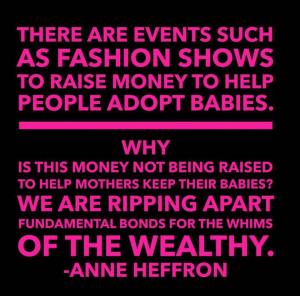
This isn’t surprising, given we’re up against issues like Anne Heffron’s points out below:
It’s not surprising, but it is discouraging. Then we have another issue: rhetoric. Are adoptees orphans (no, most are not)? Can we call adoptive parents “adoptive parents,” and should we refer to birth mothers as “first mothers” or “natural mothers” or “biological mothers”? The adoption community debates these terms extensively, confusing ourselves and definitely confounding outsiders.
And then there’s the argument over who is allowed to discuss what. Can non-adoptees speak to the adoptee experience? Should adoptive parents have any say in their children’s lives? And are birth parents really the forgotten party in the adoption discussion?
Finally–and perhaps most damningly–there’s the Angry versus Happy Adoptee distinction, an informal label bandied around to stigmatize, invalidate, and attempt to win arguments. We’re scrambling to say something new, impactful, and purposeful, but activist’s messages get lost in the flurry to push out content.
Naturally, I speak only from the transracial adoptee perspective, since that’s my lived experience and the only one I feel qualified to discuss. But even then, there’s a tendency toward defensiveness, as though I still don’t possess the necessary skill set for maintaining my position.
None of this creates an environment inviting outside stakeholders to enact change. If we’re not united, it’s challenging for others to hear our cries. But adoptees know it’s near impossible for us to agree on a stance, but we concede that adoption is not a self-directed choice.
So, as a thought experiment, I’d ask you to consider how hearing “I’m sorry you had such a negative experience” would feel if someone said that to you if you struggled with infertility before you adopted, or any of the other hard life experiences people live through that they had no control over.
Adoptees are the experts on being adopted. Still, our lives are frequently illustrated by a partially informed public, or by those whose experience doesn’t align with our own. Adoptees haven’t yet defined the line between objectifying ourselves and becoming consultants.
How do we use our voices as vehicles for meaningful change? Here’s my idea:
Temporarily set aside our anger and acknowledge that adopters and adoption agencies, like us, believe in their mission. People are more likely to listen to rational speakers.
Feature different adoption activists in our blogs, supporting each other even if we don’t 100% agree with a nuance in another’s view
Stop arguing about terminology amongst ourselves and focus on our real goals
I don’t suggest forgetting that certain terms are debatable or abandoning our passion projects. Our conversations absolutely have merit and will enact positive change. But we’ll likely never agree; adoption is too personal an issue for that to happen any time soon.
Instead, for now, I argue for coherency and collaboration. Idealistic, sure. Results-oriented? Absolutely.
Like this? Want more? So do I! Find out about my upcoming ventures on my Patreon page!
I am not a dog person. I am a “I like my dog” and a “I like about two other well-trained, non-odorous dogs” kind of person and I’m comfortable with my assessment. I’ve had 33 years to work out my preferences and I accept it.
But in the throes of one of my worst depressions (a topic I rarely speak about online), I was faced with a choice: Continue down the dangerous path I was going and find myself somewhere terrible (again), or find a way to work through the detachment I felt to everyone around me.
As an adoptee-turned-mother, momming is a harrowing experience. I’m expected to return to my son a love I never knew, accepting his vulnerability and allowing him space to express it. But when an infant is abandoned, vulnerability becomes a death sentence–if you let your guard down, someone might never come back.
So in a fit of cautious desperation, I proclaimed that we should Get A Dog. And not just any dog: We’d get a Labrador Retriever, the kind famous for being service animals and police dogs and–most importantly–highly trainable.
The expectation was this: Mindy (the Dog) would be a safe place for me to explore my adoption-related attachment issues, rather than allowing them to impact the relationship between me and my family. Less than a month later, we had Mindy.
circa February-March 2017
Dog ownership continues to have unexpected consequences, some good and some slightly confusing. However, the best part is Mindy gives me a chance to explore my attachment issues without judgment or deadlines.
Here’s what we discovered after Mindy arrived.
The cats weren’t happy – I can’t make this list without mentioning them and I’m pretty sure they can read and exact timed vomitus maximus revenge all over my floor. So there.
I’m a great dog trainer – I’m cheating a bit–Labs are eager students. But training her has given me a level of control (and a willing party) over my life, something I’ve always strived for and now find deeply satisfying. As an adoptee, our lives were determined by strangers. Now, I get to impact someone else’s life positively and see almost instant results, depending on the treat I’m holding.
Vulnerability terrifies me – This is a side effect of my home life and adoption, one that many of you may experience. In weak moments, I see her eyes looking right through me, with a trust so blind and willingly offered it sparks a visceral reaction. It helped me uncover my own issues with adoption: If you were weak, you might be abandoned. This placed me one step closer to understanding why I feel distant from my son.
Neediness = Rejection – Along with #3, she needs me. L (my son) needs me. I never felt needed in any of my personal relationships, preferring instead to consider myself disposable. But to these beings, I’m someone. I’m important. And that’s horrifying. It’s easier to reject those seeking my love because adoption left voids where self-worth should have developed.
I’m still not a social person – What is it about dogs that make people think you want to chat?
Obviously I love Mindy but what I’ve uncovered are the walls I’ve built to keep myself safe. The beauty of her company is not just her role as a playmate to my son, but exposing where I’m holding back. Until I’m able to address these issues–and I will–I’m unable to fully love those I care about the most.
Adoption, then, has taken something from me that requires extensive work to re-obtain. For many of us, adoption has taken our ability to form bonds and find safety even the homes we build after we’ve left our adoptive families.
But later, I found a poetic kind of parellel between us. She was readily left her mother and was taken from her 11 siblings without a whimper or a whine, entering my car and unquestioningly started a new life. I thought about her situation and realized how similar we were, with both of us brought into new homes and expected to just go with it.
Somehow, she fared better. She left her mother and siblings and will likely never see them again, yet accepted her situation and was already leading me home after our walks only a few days after her arrival. I, however, am left puzzled by her willingness to concede to her separation, choosing me as her Person and wanting nothing more than my company. Where I fight every attempt at inclusion, she willingly embraces it despite her losses.
I don’t understand her love and maybe I never will. But sometimes I wonder: Is it necessary?
It’s been an enlightening experience and seeing our future together and her impact on my life as I work through adoption issues is exciting. Thanks for letting me share this with you. I would love to know how pets are helping you through your adoption healing. Please share below :).
Like this? Want more? So do I! Find out about my upcoming ventures on my Patreon page!
Adoptees talk about birth moms and adoptive moms and make up clever names like “first moms.” Some of the angry ones call them worst moms.
But we don’t talk about what happens when adoptees become moms. What do we call them?
Our children call us Mommy or Momma or Mom, but I just call myself Lost.
I relate the following as my example of an adoptee’s complex relationship with motherhood, an already challenging position. I encourage adoptees to share their stories so others realize how our inauspicious beginnings follow us to parenthood.
My mother died when I was twenty-five. She endured three anxious years of surgeries and blood tests while I watched the only mother I’d ever known slowly leave me.
Wait–that’s not right. I knew another mother, but only for two-and-a-half months. And then we parted ways. When I sought her out, I discovered she died less than ten years post-me.
So I’m again mom-less, raising a son with only memories for guidance. Like any mother, I’m doing the best I can. But there’s a difference:
I envy my son.
I envy my son because at three years old he knows something I don’t–the privilege of having a consistent caregiver, one who never questioned his existence. He carelessly plays his days away, taking for granted a woman who spirits pretzels and juice and raisins to his side, knowing no different.
Apologies, but the piece I adapted this section for HAS BEEN SELECTED FOR PUBLICATION! I will link to this story once it goes live, but the overall message here will stay 🙂
For adoptees, parenting is a declaration: We survived. We carry traumas from our abandonments, yet we’re using them to make us stronger parents. Simply being present means we’ve done more for ourselves and our children than was ever done for us.
Adoptees are rewriting adoption’s definition. The literature rarely looks at adoptees as parents, making our insights invaluable to the practice. Let’s start sharing now and give them something to talk about.
Be a part of the future! If you’re interested in sharing your adoptee-turned-parent story, feel free to contact me. I’ll use our stories to weave together a long-form article on adoptee parents. Thanks!
Like this? Want more? So do I! Find out about my upcoming ventures on my Patreon page!
I am not a political person but recent events have forced my commentary on an astoundingly racist comment by – as I’m sure you know – President Donald Trump.
When I set out to write my book, I sought to uncover why an adoptive father with deeply prejudiced views would consider transracial adoption. I’m analyzing three distinct but intertwined histories: the American family, America’s anti-Asian sentiment, and, of course, the history of transracial adoption, all in an effort to explain otherwise inexplicable behavior.
But I never imagined that my country’s leader, a man describing predominantly poor and black nations as “shit holes,” would hasten my path to an answer.
And here it is:
Trump’s language is identical to my father’s, a man who’d use similar rhetoric to describe those same countries. And that superiority complex, I now realize, is what drives certain white men to determine who’s good enough to come to this country and live among their families, and who has to stay out.
Woeful bigots who transracially adopt might have complex motives rooted in what I continue to uncover, but never has an answer to a deeply complex question been presented to me with such appalling clarity. If racism trickles down from the top, then we have an even more complicated issue to address: How do we protect ourselves against forces so powerful and how can we prevent this from happening again?
For one, we cannot allow ignorant white men’s opinions to pit minorities against each other. It’s a vicious attempt to assign racial hierarchies among human beings. We need to view their commentary through a lens of insecurity and inferiority, the basic root of all immigrant-directed nativistic racism.
I hope that Trump’s comments unite people of all colors against such despicable language. I also hope that this event provokes immigrants to loudly tell their stories, so that we may continue documenting the struggles we encounter every single day.
Thanks, all of my readers, for letting me veer off the path a bit :). You mean the world to me!
Like this? Want more? So do I! Find out about my upcoming ventures on my Patreon page!
Like many angsty teens, I wanted a chasm to open up and suck me in so I’d never have to face this cruel, cruel world anymore, but again, like many angsty teens, what I really wanted was as much attention as possible. I wanted someone to look at me and say “Yes, you are different and yes, you’re Asian. That’s cool. Now where’s that five dollars you owe me?”
What I received was the complete opposite. I heard “I see your face and it’s offensive and so freaking weird that it exists within your White family. Now let me ask you about it!” (These are calledintrusive interactions and they’re as awkward as they sound.)
But something slightly disturbing happened whenever I’d complain about these unwanted behaviors; I’d be accused of imagining things, of being overly sensitive, of not humoring other people’s curiosity. Worse yet, I’d be told that it was something else about me, some indescribable flaw that made me a target. Evidently, “I’m going to kick your eyes straight!” and “Go back to your own country” have nothing to do with my appearance.
Eventually, my mother would tell me I dreamt these things up and that if they really were happening, I should just stop drawing so much attention to myself (leading me to pen a piece calledShut Up and Smile, in response to misplaced blame).
Her reaction – and society’s as a whole – to subtle forms of racism (aka racial microaggressions) is a quietly dangerous one, serving only to perpetuate the cycle of victim-blaming. The below video is an entertainingly informative few minutes of Derald Wing Sue’s definition of racial microaggressions, but the YouTube comments are perhaps the most telling status of America’s view of race.
I’ll save you the pain of reading through the comments; like everything on the internet, they’re filled with hate and racism and spew forth rage, accusing the professor of imagining things that aren’t really there, telling minorities to grow a thicker skin.
For the transracial adoptee, we need to be particularly sensitive to how racism is handled by both ourselves and our families. While finding racism where it doesn’t exist isn’t helpful for anyone, transracial families should accept that overt acts of hate, like shouting slurs or getting beat up, exist alongside more slippery ones that evade quantification.
But there’s a solution. All forms of racism, such as colorblindness and hopeless commentary like this:
Person For Whom The System Was Made To Benefit Recommends We Stop Criticizing The System pic.twitter.com/XRoXb6pLQT
need to be considered, addressed, and handled. Directly. Be the awesome White parent who acknowledges your child’s race without the dreaded whitewash.
Vagaries like “hate for hate’s sake is bad” can be more effective if discussions include specific topics like White privilege and the history of the child’s ethnic group in this country. Admit to the color gap between you and your child; this isn’t an act of mercy or sacrifice or guilt-tripping, but one of empowerment for the future adult you are raising. Doing so will firmly cement your child in a position of security, because her status as a person of color will not be denied.
Celebrating color is not enough – we must concede that White parents and their transracial children will live vastly different lives based solely on race; we must embrace this truth as a starting point for weaving our developing values together. By starting this journey at home, parents have tremendous potential to positively influence their child’s racial identity.
Like this? Want more? So do I! Find out about my upcoming ventures on my Patreon page!
Today’s article is inspired by a Facebook post in one of my Korean adoptees’ groups, speaking closely to several topics in my work-in-progress. How do we measure Asian attractiveness; or, how do we measure any person of color’s attractiveness?
His post highlights an unfortunately prevalent beauty standard where White/Caucasian is the ring for which POC should reach. The article showed a bevy of gorgeous faces, Eastern in origin but with one key characteristic: They’re Asian, but not too Asian.
The Facebook user provided this (unedited) commentary:
You would never see a Chinese person on this list with a wide nose or a Filipino with dark skin. And if they do feature dark-skinned POC they always have to have thin AF noses and seafoam green eyes. They only praise us when we resemble the beauty of white people.
Gorgeous, but not too Asian.
This is indeed why eyelid surgery and nose jobs are so popular in Asia and it’s exactly the reason I grew up hating my own appearance.
In my case, as I’m sure is the case in many other adoptees’ experiences, I grew up studying my family’s Whiteness, analyzing my mother’s blonde hair, large blue eyes, and her long, straight Caucasian nose. I clung hopelessly to my father and brother’s dark hair and dark eyes, convincing myself that we shared similar features and thus I could pass as them – White.
While the less enlightened of us (or more generously, the optimists) might counter with “You should love yourself the way you are!”, let’s examine that sentiment.
Loving your appearance requires that our internal and external expectations for our image must match; for example, I was raised in a very anti-POC community with White-dominant values. Anything else was ugly, scary, or unacceptable. My flat face and watermelon eyes became immediate targets for haters, offensive enough to provoke spiteful commentary by classmates. At some point, my parents even rejected interracial relationships (Black/White), while their Asian daughter dated only Whites.
The ultimate message: Asian is bad, your face is worse. For many years – and even up until this point – I despised having my photo taken in profile; it only enhanced my face’s flatness, drawing a thick line between myself and the pristine profile shots of White-girl models in glossy teen magazines. At one point, my mother suggested a nose job once I got older, informing me that I lack a bridge, a feature fixable via plastic surgery.
Later, the Internet led me to articles on ethnic plastic surgery, a medical phenomenon brought on by both a wealth of disposable income and a plethora of Western values. When I shared this tidbit with friends and family, they were rightly horrified but the depth of their reactions tempered by their lack of lived experience within a non-White body.
Through my research and my chats with others, I’ve inferred that being raised in an ethnically diverse community makes a significant difference, and I would agree only based on my current adult experience. No one bats an eye at my mixed family or son when we go to the Asian food market or walk the streets of Philadelphia; this isn’t saying that our appearances don’t raise eyebrows for some – I’m not naïve – but the likelihood of us eliciting some type of exotic wow response by the majority of acquaintances is much lower.
One of the most humiliating experiences I ever had – well, one of the top ten anyway – was when my mom took me to the make-up counter in our local mall. Keep in mind that I lived in a White non-diversified area, where Italian was considered foreign cuisine. She intended to get me a prom-makeover. The counter girl undoubtedly lacked experience applying eyeliner, eyeshadow, and foundation to an Asian palette; without double eyelids and with yellow-toned skin, I came away looking like I got punched in the eye and subsequently spent a week recovering in the hospital.
I finally understood how vastly my face differed from those around me and required care unique to my race – something that would have been taught to be if I’d been adopted in-race. Similarly, my hair confounded my mom’s (White) hairdressers. No matter how much they razored, sheared, and thinned my coarse hair, it just wouldn’t fall into the ’90s Jennifer Aniston layers of the day. I lived through two perms in an effort to achieve that turn-of-the-century crunchy-haired look (failing, obviously), again deluding myself that I was this close while most likely fooling no one around me.
I understand the complexities though. It’s become impossible to admire someone of color without being accused of fetishization or holding the non-White up on some strange exotic pedestal. In my experience, I remember being told by the last remnants of Korean War vets that we were all “beautiful, beautiful people,” making me wonder if even the ugly ones of us were beautiful, or if our strangeness made us attractive.
Perhaps it was also just my unfortunate experience, but I’ll relate this unflattering anecdote for educational purposes only:
I wanted to wear the thick-framed, black-rimmed hipster glasses for the same reason every other early twenty-something did; it was fashionable and obvi expressed my edginess, like come on. My mom was anti-dork glasses for whatever reason, but after pleading with me to get rid of them, she finally dropped this one: They make your face look flatter.
Not only did I not stop wearing them after that, but I filed her words away into the forefront of my mind, the place where painful memories swish around, reminding you to keep your defenses up. Using racialized facial features to discourage following a fashion trend is ineffective, small-minded, and racist. I’d presume it’s also an occurrence that POC regularly confront, adoptees possibly more.
For transracial adoptees especially, we need to find support – outside of our families – to help develop positive self-image and racial appreciation; no one wants their child to be a self-hating anything, so transracial parents require awareness of not just their child’s larger culture, but their child’s unique needs with regards to self-care and facial features. Transracial parents should be prepared to adjust trends according to their child’s needs; this isn’t racist, it’s prudent. Just as a White parent of a Black child would learn hair care and other nuances, parents of Asian children and others require similar education.
But I know there’s more to changing the beauty narrative than simply figuring out how to apply makeup or cut hair. It’s a larger issue that’s finally being addressed by increasing numbers of POC – particularly Asians – in mass media, which will help normalize their appearance and provide guidance that a parent cannot.
Transracial adoptees and their parents are in a powerful position: We live within the minority and majority, making us privy to subtletities others miss. We can use this knowledge to spur progress in so many ways, including that of beauty standards.
I acknowledge I’m writing from a purely Americanized viewpoint, but I welcome your thoughts on this topic and I’d love to hear your encounters with this unfortunate byproduct of Western society!
Like this? Want more? So do I! Find out about my upcoming ventures on my Patreon page!
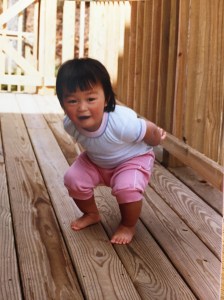
When I was old enough to understand basic commands, my father trained me to perform a Mexican hat dance on cue. Another bizarre trick had me headbanging when he said “DONG!” This continued until I was around age three or four; I discovered humiliation and refused to put on any more shows for the video camera or family friends.
It was then that I, their little Korean refugee, was no longer considered “fun.”
Position assumed, followed by tap-dancing around an imaginary sombrero. #unfortunateimplications
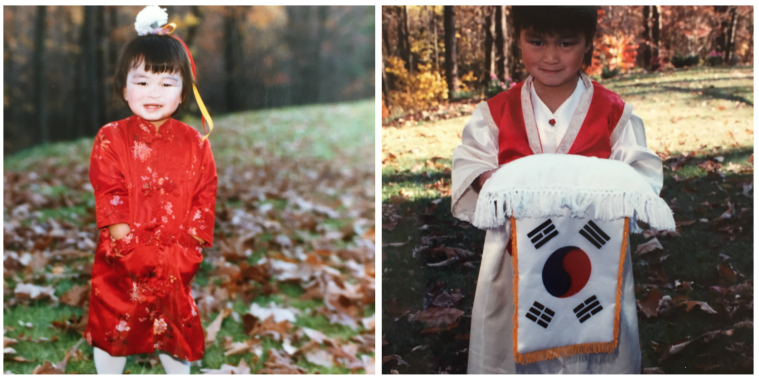
Halloween was their chance to shine. Like a doll, mom forced me into a gifted Chinese dress (I’m Korean), caked on white facepaint, and squeezed my chubby toddler feet into pointy rubber Chinese shoes. The following year, I wore a hanbok; instead of a trick-or-treat bag, I carried a pillow with a South Korean flag pinned to it.
As I struggled toward adulthood, I remained their perpetual Korean orphan, an amusing participant for their parlor games. Through growth and distance, I bastardized their original presumption that Koreans were “quiet, trouble-free, responsible and achieving people”; in fact, I was regularly reminded that if I were still in my home country, I wouldn’t make it because I’m too loud, too demanding, too me.
The adoptee is caught between, spoken for, treated as a purpose, or a context, as a way to improve the adoptive parent or agency, as something to be learned from or ignored, as less an individual with her own agency and more a contribution to the agency of someone else. –Matthew Salesses
I discuss this subject in my book, looking at how innocent-seeming heritage appreciation and assimilation attempts by White parents can quickly transform into racial microaggressions, or in other cases, outright aggression. South Korea’s recent apologies to adoptees haven’t helped; instead, they remind the public that we’re “pathetic and pitiable orphan[s] and…lucky transnational émigré.”
Though all this leads to tangled identity crises that I hope to unscramble, I don’t believe it was totally malicious. My parents did the best they could, espousing the then-celebrated and now-derided 1980’s colorblind theory, a societal failing that I’m working on dissembling. I seek to portray them – and other well-meaning White adoptive parents – as victims of misaimed marketing, cultural norms, and – in my parents’ cases – insular upbringings.
Like this? Want more? So do I! Find out about my upcoming ventures on my Patreon page!






 a critical discourse.