white like me

When I was twelve, my mother – who loved surprising me with books – brought me Black Like Me.  Until then, she’d never shown any interest in racial studies.

nicole-mason-19736
Photo by Nicole Mason on Unsplash

Because of her unusual book choice, the story stuck with me. Although John Howard Griffin’s experiment gets the side eye today, at the time his work validated my struggle. Griffin felt the stares, got asked the probing personal questions, and experienced society’s subtle way of disenfranchising minorities. To me, he was the first White person who got it.

Of course, minorities can speak for themselves now, eliminating the need for a White male translator (though some still try). However, transracial adoptees occupy a unique space in racial conversations. Since we’ve lived as racial others within our families and communities, we know that sometimes it is what’s outside that counts.

But what does being Asian feel like? Or White? Does it feel like…anything? I believe the question should really be: What does not being White feel like?

*

Dr. Anna R. McPhatter, Dean of Social Work at Morgan State University,  suggests that  “[w]e are all burdened with the Eurocentric bias that is the foundation of our formal and informal education.” I’d also apply this to family structure: We assume that families in the United States are racially homogenous. Anything different still raises eyebrows.

Transracial adoptees, though, challenge that belief: We take on our White family’s identity despite our visual appearance.

Korean adoptees desire to perform a White identity, but these performances are disrupted when others initiate communication about their Asian identities. – Sarah Docan-Morgan

But identities are fragile. In 2010, Sara Docan-Morgan reported that adoptees often find their family status challenged.  Questions like “Now who is this?” and “Is she really yours?” frustrate adoptees; as noted above, these remind us of the “exclusive conceptualization of families as biologically related and also [cause] confusion about how people could question the bonds between [the adoptee] and the only people [s/he] knew as family.”

Intrusive interactions, defined as “interpersonal encounters wherein people outside the immediate family question or comment on the adoptee and/or the adoptive members’ relationships with one another,” threaten an adoptee’s sense of security, as both a family member and an ethnic individual.

As McPhatter says: “People of color are adept at reading the slightest nuance or cue that carries even the most carefully concealed message of disapproval, discomfort, or nonacceptance because of one’s race, culture, or ethnicity.” Transracial adoptees are no different and in fact, may be slightly hypersensitive because of our constant racialization by others.

*

In any case, transracial adoptees spend their lives as outsiders, regardless of how well-accepted they were by their families. Our status as both immigrants and racial minorities makes us particularly vulnerable to how others perceive us.

*

I think this is an important start to a larger conversation that could truly benefit transracial adoptive parents. Many TRAps ask how they can support their children in racial identity development, so I’ll be continuing this topic in my next post!

*

All references can be found here.

Like this? Want more? So do I! Find out about my upcoming ventures on my Patreon page!

i’m not your model

I read an article from the 1990s that confirmed my long-standing suspicions: People in the eighties didn’t believe racism against Asians existed, thanks to the (now dissipating) model minority myth.

…[T]he erroneous belief that Asian Americans do not face discrimination cloud and mask the oppression of Asian Americans. We must tell our stories and our history again in order to shatter the myth and other mistaken beliefs about Asian America. – Robert S. Chang

Robert  S. Chang, law professor, wrote an awesomely-angry-ish paper examining the role Asian Americans played in the legal system. Unsurprisingly, Asians were not major characters. Chang explains the hidden-in-plain-sight prejudices launched against Asians, starting from the laws written by our very own United States government.

For example, he raised my eyebrows more than once when he shared tidbits like, oh, the fact that the official quota on Chinese immigrants was lifted less than 25 years before my birth. And those same early immigrants faced harsh discriminatory laws that “[l]ater arrivals, trying to avoid this discrimination, distanced themselves from earlier arrivals….In essence, the discriminatory laws…not only hurt the Chinese…but, by encouraging each group to be more ‘western’ than the next, also prevented the building of coalitions among different Asian American groups.”


vance-osterhout-129608
Photo by Vance Osterhout on Unsplash

Following the natural progression of institutionalized racism, White government officials excluded Asians from minority representation almost entirely, believing Asians chose to only socialize with other Asians – despite laws forcing separation.

Chang drops another bomb: It wasn’t until 1992 that language diversity – a feature of many Asian American cultures – was introduced to voting ballots, effectively banning some Asians from political participation.

In my book, I argue that racial attitudes during and before my adoption explained my negative reception. Insular town notwithstanding, I suspected what Chang confirmed: Asians were harbingers of foreignness and the insults (“Go back to your own country!”) reflected the belief that Asians didn’t belong; not in the town and definitely not the United States.

Chang argues that it’s the “portrayal of Asian Americans as successful [that] permits the general public, government officials, and the judiciary to ignore or marginalize the contemporary needs of Asian Americans.” Then, “when we try to make our problems known, our complaints of discrimination…are seen as unwarranted and inappropriate.”

So that’s why no one cared when someone threatened to kick my eyes straight.

And that’s why action wasn’t taken when “chink” mysteriously appeared on my school poster.

And, most upsettingly, that’s why the so-called affirmative action officer in my middle school told me that the kid who tried to light my jacket on fire while I was wearing it “needed a friend,” and never addressed the racism.

So, what does this have to do with adoption? I share this (thank you Mr. Chang, if you ever read this, which you probably won’t) because a large section of my book argues that the rapid rate of Korean adoptions were proportionate to the growing anti-Asian sentiment in the US, and steps could have been taken to prevent the inevitable racism I – and many others – experienced. Knowing this would have also maybe helped prepare my parents and possibly led others to self-select out of the adoption process.

Surviving in a multiracial world is challenging, but parents who are unable or unwilling to help their transracial child navigate it are dangerous.  It shouldn’t take this much work to prove racism is real.

Like this? Want more? So do I! Find out about my upcoming ventures on my Patreon page!
dance for me, kid

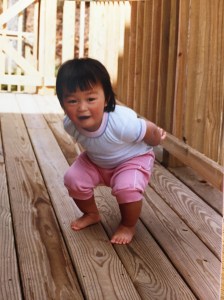
When I was old enough to understand basic commands, my father trained me to perform a Mexican hat dance on cue. Another bizarre trick had me headbanging when he said “DONG!” This continued until I was around age three or four; I discovered humiliation and refused to put on any more shows for the video camera or family friends.

It was then that I, their little Korean refugee, was no longer considered “fun.”

mexican hat dance
Position assumed, followed by tap-dancing around an imaginary sombrero. #unfortunateimplications

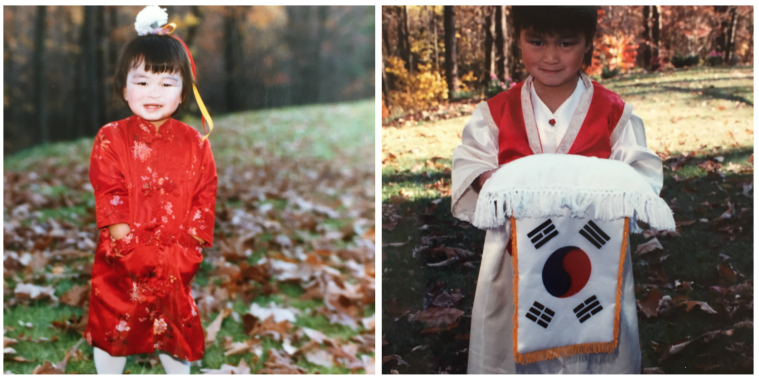
Halloween was their chance to shine. Like a doll, mom forced me into a gifted Chinese dress (I’m Korean), caked on white facepaint, and squeezed my chubby toddler feet into pointy rubber Chinese shoes. The following year, I wore a hanbok; instead of a trick-or-treat bag, I carried a pillow with a South Korean flag pinned to it.

collage
#cultureequalscostume

As I struggled toward adulthood, I remained their perpetual Korean orphan, an amusing participant for their parlor games. Through growth and distance, I bastardized their original presumption that Koreans were “quiet, trouble-free, responsible and achieving people”; in fact, I was regularly reminded that if I were still in my home country, I wouldn’t make it because I’m too loud, too demanding, too me.

The adoptee is caught between, spoken for, treated as a purpose, or a context, as a way to improve the adoptive parent or agency, as something to be learned from or ignored, as less an individual with her own agency and more a contribution to the agency of someone else. –Matthew Salesses

In the above quote, Salesses pointedly offers a nuanced view of an adoptee’s self-defined purpose. I agree with him, and would argue that it’s partially because the “general public still broadly understands Korean and other Asian adoptees as child foundlings who are lucky to have the opportunity to become American.” When transracial adoptees grow up, we no longer wish to be marionettes for families built on misconceptions, even though some of those illusions were enforced by our placing agencies. In fact, many adult Korean adoptees “describe a diminishing relationship to family during and after the expansion of their Korean adoptee identities.” It’s no surprise they’re staging a quiet rebellion.

I discuss this subject in my book, looking at how innocent-seeming heritage appreciation and assimilation attempts by White parents can quickly transform into racial microaggressions, or in other cases, outright aggression. South Korea’s recent apologies to adoptees haven’t helped; instead, they remind the public that we’re “pathetic and pitiable orphan[s] and…lucky transnational émigré.”

Though all this leads to tangled identity crises that I hope to unscramble, I don’t believe it was totally malicious. My parents did the best they could, espousing the then-celebrated and now-derided 1980’s colorblind theory, a societal failing that I’m working on dissembling. I seek to portray them – and other well-meaning White adoptive parents – as victims of misaimed marketing, cultural norms, and – in my parents’ cases – insular upbringings.

Like this? Want more? So do I! Find out about my upcoming ventures on my Patreon page!
i don’t hate my parents

There. I said it. So now that we’ve taken care of that, let me explain.

Two unshakable fears follow me from word to sentence to paragraph as I continue through this project. One includes being accused of parental ingratitude, unable to just accept my situation and grow up. The other involves being on the receiving end of the Internet’s wrath. I can handle that one.

But let’s sit with that first fear for a bit.

To an adoptee, “gratitude” implies being blissfully happy with your life circumstances, taking the good with the bad and accepting it over whatever the alternatives may have been. But it’s a loaded expectation. It silences a person’s ability to question their own upbringing. It’s also a powerful denial (and sometimes a way to blame the adoptee) of any unfortunate experiences.

So why the silence?

First, there exists in the literature an implication of the American savior complex. When I was adopted more than three decades ago, there was a persisting post-war mentality that our neighbors to the East were backward, third-world, and in need of American intervention. This attitude pervaded the original marketing materials for Korean adoption and helped satisfy America’s growing nationalism – after all, what God-fearing American citizen didn’t want to offer their home to a “Korean waif”?

Second, because of this climate, transracial adoption as a concept was publically viewed as the Ultimate Good Deed. Opening your home to a “needy” child certainly cannot be a punishable offense. But this glowing picture overshadowed the growing controversy surrounding the original Korean orphan advocate, Harry Holt, who was criticized for his unconventional adoption practices.

Nevertheless, the picture of the Asian as a “quiet, trouble-free, responsible and achieving people” persisted – and then I arrived. These jumbled assumptions provided for one loaded welcome, with high expectations and an underlying presumption of an eternally happy child.

But that’s just the problem – that child grows up.

And here’s where I am today – just an ordinary person with thoughts and reflections on her life, coupled with the desire to help validate others’ experiences. I happen to be adopted, but that’s not how I define myself. And neither should any adoptee, since that’s a label assigned to us that wasn’t of our choosing.

So now it’s my turn to tell my story, to stave off a history of puzzled expressions and intrusive questions and forced explanations of my personal history. It’s a validation for anyone who was ever confronted with an outright rejection of their tentative criticisms of their parents, family, or racial identity crises – you are not alone, you are not wrong, and to some degree, our struggles were predicted by concerned researchers over fifty years ago.

I will explore many of the concepts in each post in more depth in my book, but I hope you enjoy my ongoing thoughts and contribute your own so we can have an insightful conversation. I love hearing different viewpoints and your feedback will help me develop a better final product that’s really made for you.

Like this? Want more? So do I! Find out about my upcoming ventures on my Patreon page!

no, i’m not “anti-adoption”

This has become a point of contention for many people. I’ve decided to repost this just as a friendly reminder.

I am not an absolutist, especially in very human situations like adoption and race.

People must remember not to confuse critical discussion with opposition. Real change can’t happen unless we allow ourselves to think openly and analytically.

headdesk

Updated 5/31/18

Before you angrily push the “share” button and furiously type a non-flattering explanation of my site, I’ll clarify my position: I am not anti-adoption, nor am I happily bouncing my way into that “pro-” category.

Thanks to the Internet’s uniquely divisive nature, I need to proclaim my stance in the most neutral, succinct way. And here it goes:

yawning cat - leusink
Photo by Erik-Jan Leusink on Unsplash

I am “adopt transracially with extreme prejudice.”

This means:

  • Doing legit research (not just blogs, reddit groups, or other online echochambers)
  • Realistically evaluating your understanding of race and your attitudes toward it
  • Reviewing the community in which you live and objectively assessing its ethnic-friendliness
  • Reading perspectives from both sides of the adoption experience and anticipating potential issues

It also means really, truly sitting with your expectations for transracial adoption and really, truly, honestly appraising your ability to provide for the unique needs of a transracial child.

This may mean listening to anyone else but your family and friends and maybe hearing a transracial adoptee’s (TRAd) perspective, peppered with some honest-to-goodness academic research.

Since there are no hard and fast guidelines established yet for navigating these complexities, I’ll offer suggestions (not solutions) based on forty-plus years of research on the subject and leave you to determine what best works for your family. My hope is that you’ll find some common threads that pull it all together and pick out what works for you.

If you are considering transracial adoption,  this site’s for you.

If you are a transracial adoptive parent (TRAp), this site’s for you.

If you are a TRAd, this site’s for you.

If you are simply interested in exploring racial complexities and how adoption isn’t the solution to ending racial problems, then I think you’ll want to sit and stay awhile.

Like this? Want more? So do I! Find out about my upcoming ventures on my Patreon page!