blog posts

Society’s Perpetual Children: An Introduction to the Adoptee Condition (Part One)

The mismatch in expectations versus reality for adoptees and non-adoptees is obvious. To expand adoption’s relevancy, this ongoing longform series provides a high-level view of adoptees’ current perspectives. I’ll attempt to uncover why adoptee writing stays relegated to niche groups or newsletters; why adoptee mistreatment and abuse makes ripples only amongst those affected; and what we can do to simply care. By moving away from adoptee-as-child terminology and welcoming non-adoptees into the conversation, we can begin taking their experiences seriously.
dear adoption
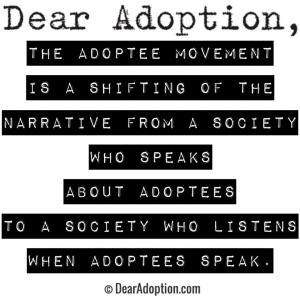
Dear Adoption–great site with amazing perspectives.

There exists a group of people, foreigners within their own families, who form kinship from strangers’ blood. Adopted as babies and children and teens, they mature into adulthood yet remain forever frozen as society’s adopted children.

It doesn’t matter how assimilated adoptees become, into their new families or into new cultures if immigrating from another country. For some reason, they’re referred to — even by government representatives — as children. Adults adopted as a result of wartime conflicts, like Amerasians of the Korean War or the Vietnamese left behind after that war, have clearly aged into adults. Many, like Lynelle Long, become activists who meet with country officials to voice their concerns with the practice. Despite their accomplishments, though, they’re still viewed as the children sent away.

Why are we categorizing a subset of our adult population this way?

Adoptees have known two mothers, two lives, and migrated within two worlds, sometimes jarred violently from a womb to a stranger’s waiting arms. Adoptees survive this and develop into mostly capable adults, but then have their frequently traumatic experiences buried under childlike descriptions.

There is a reason for this stasis.

Society still devours happy endings. Adoptees are the ultimate humanitarian symbol: Presumably unwanted, a willing family took a child in and saved them, imbuing an aura of childlike wonder around them. Refugees and orphans become a parent’s act of charity and love. What could be better than that?

But admitting the adopted child grows up means acknowledging that we may have objectified a human being. To remedy the mistake, adoptee experiences that don’t align with our expectations are discredited.

It’s time to #JustListen.

The Curious Phenomenon

Ending the story once an adoption’s finalized creates a curious phenomenon: We tune out the object of fascination, hearing from them only what validates our values.

In an era where hasty generalizations are eschewed, the population most impacted by adoption — adoptees —  remains largely overlooked.

Some adoptive parents make cutesy videos about their adoption announcements, garnering thousands of views, shares, and outpourings of financial and emotional support. (Note: I do not support that video. At all.)

Once the object — the child — is obtained, the story ends. At least for the adoptee.

The parent’s journey continues. Their struggles raising a child with predictable attachment and other behavioral issues become the parent’s burden, not the child’s. Here the parents are at an advantage, getting to tell their story before the child has the vocabulary necessary to speak out.

The adoptee doesn’t get the opportunity to speak, at least not until they’re older, when their disgruntled blogs and tweets and Facebook statuses are overshadowed by their parent’s love and selfless devotion. By then, the child has become trapped in a sort of suspended animation; always adopted, yet expected to accept — without question — their circumstances.

Yet — and here’s where it’s really curious — many kids, especially adolescents, experience turbulent, ragey years. As a natural reaction to the dichotomy of budding independence yet still dependent upon parental financial and emotional support, teens rebel. But adoptees, already hampered by origin issues and (for transracial adoptees) racial identity confusion, act out even stronger, filtering frustration from a place more primal than simple teenage rebellion.

They’re expressing grief. Deep, traumatic grief, couched in abandonment issues that manifest themselves as relationship difficulties, drug or alcohol abuse, or — in some cases — suicide.

And even so, reports focus on how much the parents struggled with the child’s behavior, how much effort was wasted on someone who was selfishly unreceptive to love.


When any child has serious troubles, it’s a tragedy for that child and the family. When the adopted child has problems, it’s personal. It’s a direct insult and a bitter truth: Love isn’t always enough. That truth manifests as resentment on a parent’s and greater society’s behalf; after all, if a practice so rooted in love and selflessness could be so easily dismissed by the “saved,” it’s easier to blame the victim than address the problem’s roots.

The Invisible Minority

There’s another reason we need to pay attention to adoptee voices.

Adoptees are the ones with first-hand experience in a system that took away their control, but no one seems to hear what they’re trying to say.

They live and work alongside you, but you’d never know their secret. They’re part of a population with life stories that began with true uncertainty and unwant. They encompass all races and hail from a plethora of countries.

They began their lives with loss and gains, asked for and about but never just asked.

Still, adoption remains an uncomfortable topic for some, an insult for others, or, in its extreme, a divine act proposed by God. Even as adoptee activists write strongly-worded missives against the practice, create catchy hashtags (#BeingAdoptedMeans and #JustListen are the popular ones), and maintain well-trafficked blogs, they only garner mass attention when something ugly happens.

Take, for instance, the South Korean adoptee who was deported then committed suicide in his “home” country. Or the recent article about the three-year-old girl murdered by her adoptive parents. Obviously these incidents belie any happy ending, though some are still inclined to believe these are one-offs in a largely beneficial system.

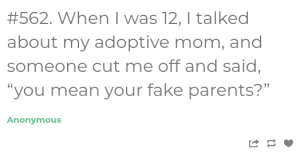
When adoptees speak out about the practice — mind you, they’re not doing it as a reactionary measure but in addition to these tragic events — they’re ignored or challenged:
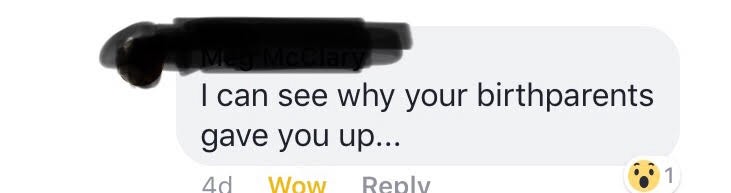
This was actually said by an adoptee to another adoptee — the cannibalism is real.

If this were any other group clamoring for attention, I believe they’d be much more successful. Instead, it remains easier to cling to myths and maybes about a practice than systematically change our opinions. And when adoptee protests are drowned out by kitchsy videos and GoFundMe requests by prospective adoptive parents, adoptees are seen as ungrateful bitter jerks.

With minority status, perhaps their activism will be taken more seriously; rather than being viewed as ungratefuls rebelling against their saint-like parents, they’ll hopefully emerge into mainstream conversations as a marginalized group long misunderstood by stereotypes and stigmas.

Curiouser and curiouser.

Facing Forward

As families change shape and form, as reproductive technologies and the definitions of motherhood and fatherhood blur, adoptees cannot and should not be overlooked in these discussions.
Screenshot 2018-02-07 at 4.38.35 PM
Courtesy of Confessions of an Adoptee

After all, adoptees asserted their space in a society that still prioritizes biological relations. Adoptees, perhaps, are society’s pariahs. They don’t deserve that status. Adoptees were among the first to rewrite our country’s perception of the traditional family, yet are assigned passive roles. It’s the notion of the adopted child that keeps them ignored.

Part Two of this series will look at America’s role in creating adoption insults and America’s historical relationship with the traditional family.

Feel free to follow me so you don’t miss the next update!

Like this? Want more? So do I! Find out about my upcoming ventures on my Patreon page!

adopting motherhood

aleksandar-popovski-50818.jpg

Adoptees talk about birth moms and adoptive moms and make up clever names like “first moms.” Some of the angry ones call them worst moms.

But we don’t talk about what happens when adoptees become moms. What do we call them?

Our children call us Mommy or Momma or Mom, but I just call myself Lost.

I relate the following as my example of an adoptee’s complex relationship with motherhood, an already challenging position. I encourage adoptees to share their stories so others realize how our inauspicious beginnings follow us to parenthood.


My mother died when I was twenty-five. She endured three anxious years of surgeries and blood tests while I watched the only mother I’d ever known slowly leave me.

Wait–that’s not right. I knew another mother, but only for two-and-a-half months. And then we parted ways. When I sought her out, I discovered she died less than ten years post-me.

So I’m again mom-less, raising a son with only memories for guidance. Like any mother, I’m doing the best I can. But there’s a difference:

I envy my son.

I envy my son because at three years old he knows something I don’t–the privilege of having a consistent caregiver, one who never questioned his existence. He carelessly plays his days away, taking for granted a woman who spirits pretzels and juice and raisins to his side, knowing no different.

Apologies, but the piece I adapted this section for HAS BEEN SELECTED FOR PUBLICATION! I will link to this story once it goes live, but the overall message here will stay 🙂

For adoptees, parenting is a declaration: We survived.  We carry traumas from our abandonments, yet we’re using them to make us stronger parents.  Simply being present means we’ve done more for ourselves and our children than was ever done for us.

Adoptees are rewriting adoption’s definition.  The literature rarely looks at adoptees as parents, making our insights invaluable to the practice. Let’s start sharing now and give  them something to talk about.


Be a part of the future! If you’re interested in sharing your adoptee-turned-parent story, feel free to contact me.  I’ll use our stories to weave together a long-form article on adoptee parents. Thanks!

Like this? Want more? So do I! Find out about my upcoming ventures on my Patreon page!

news: a new medium for my medium

Hey all! As if you couldn’t get enough of me, I’m publishing over at Medium in addition to maintaining blog posts here. Those articles are a bit different than on this site so I hope you enjoy them.

As always, feel free to share and comment. I always love your feedback.

igor-ovsyannykov-284219

Take a look at my first two pieces:

Five Potential Side Effects of Transracial Adoption
Because families aren’t born from rainbows and unicorn sh*t

Why I Can’t Pick a Side in the Adoption Debate (Right Now)
AKA Please Don’t Attack Me Yet

Like this? Want more? So do I! Find out about my upcoming ventures on my Patreon page!

and in other news: shithole countries

I am not a political person but recent events have forced my commentary on an astoundingly racist comment by – as I’m sure you know – President Donald Trump.

When I set out to write my book, I sought to uncover why an adoptive father with deeply prejudiced views would consider transracial adoption. I’m analyzing three distinct but intertwined histories: the American family, America’s anti-Asian sentiment, and, of course, the history of transracial adoption, all in an effort to explain otherwise inexplicable behavior.

But I never imagined that my country’s leader, a man describing predominantly poor and black nations as “shit holes,” would hasten my path to an answer.

And here it is:

Trump’s language is identical to my father’s, a man who’d use similar rhetoric to describe those same countries. And that superiority complex, I now realize, is what drives certain white men to determine who’s good enough to come to this country and live among their families, and who has to stay out.

Woeful bigots who transracially adopt might have complex motives rooted in what I continue to uncover, but never has an answer to a deeply complex question been presented to me with such appalling clarity. If racism trickles down from the top, then we have an even more complicated issue to address: How do we protect ourselves against forces so powerful and how can we prevent this from happening again?

For one, we cannot allow ignorant white men’s opinions to pit minorities against each other. It’s a vicious attempt to assign racial hierarchies among human beings. We need to view their commentary through a lens of insecurity and inferiority, the basic root of all immigrant-directed nativistic racism.

I hope that Trump’s comments unite people of all colors against such despicable language. I also hope that this event provokes immigrants to loudly tell their stories, so that we may continue documenting the struggles we encounter every single day.

Thanks, all of my readers, for letting me veer off the path a bit :). You mean the world to me!

Like this? Want more? So do I! Find out about my upcoming ventures on my Patreon page!

now you see me, but they don’t: invisible faces and races

Like many angsty teens, I wanted a chasm to open up and suck me in so I’d never have to face this cruel, cruel world anymore, but again, like many angsty teens, what I really wanted was as much attention as possible. I wanted someone to look at me and say “Yes, you are different and yes, you’re Asian. That’s cool. Now where’s that five dollars you owe me?”

What I received was the complete opposite. I heard “I see your face and it’s offensive and so freaking weird that it exists within your White family. Now let me ask you about it!” (These are called intrusive interactions and they’re as awkward as they sound.)

But something slightly disturbing happened whenever I’d complain about these unwanted behaviors; I’d be accused of imagining things, of being overly sensitive, of not humoring other people’s curiosity. Worse yet, I’d be told that it was something else about me, some indescribable flaw that made me a target. Evidently, “I’m going to kick your eyes straight!” and “Go back to your own country” have nothing to do with my appearance.

Eventually, my mother would tell me I dreamt these things up and that if they really were happening, I should just stop drawing so much attention to myself (leading me to pen a piece called Shut Up and Smile, in response to misplaced blame).

Her reaction – and society’s as a whole – to subtle forms of racism (aka racial microaggressions) is a quietly dangerous one, serving only to perpetuate the cycle of victim-blaming. The below video is an entertainingly informative few minutes of Derald Wing Sue’s definition of racial microaggressions, but the YouTube comments are perhaps the most telling status of America’s view of race.

I’ll save you the pain of reading through the comments; like everything on the internet, they’re filled with hate and racism and spew forth rage, accusing the professor of imagining things that aren’t really there, telling minorities to grow a thicker skin.

For the transracial adoptee, we need to be particularly sensitive to how racism is handled by both ourselves and our families.  While finding racism where it doesn’t exist isn’t helpful for anyone, transracial families should accept that overt acts of hate, like shouting slurs or getting beat up, exist alongside more slippery ones that evade quantification.

But there’s a solution. All forms of racism, such as colorblindness and hopeless commentary like this:

need to be considered, addressed, and handled. Directly. Be the awesome White parent who acknowledges your child’s race without the dreaded whitewash.

Vagaries like “hate for hate’s sake is bad” can be more effective if discussions include  specific topics like White privilege and the history of the child’s ethnic group in this country.  Admit to the color gap between you and your child; this isn’t an act of mercy or sacrifice or guilt-tripping, but one of empowerment for the future adult you are raising. Doing so will firmly cement your child in a position of security, because her status as a person of color will not be denied.

Celebrating color is not enough – we must concede that White parents and their transracial children will live vastly different lives based solely on race; we must embrace this truth as a starting point for weaving our developing values together. By starting this journey at home, parents have tremendous potential to positively influence their child’s racial identity.

Like this? Want more? So do I! Find out about my upcoming ventures on my Patreon page!

what’s hot, what’s not

Today’s article is inspired by a Facebook post in one of my Korean adoptees’ groups, speaking closely to several topics in my work-in-progress. How do we measure Asian attractiveness; or, how do we measure any person of color’s attractiveness?

His post highlights an unfortunately prevalent beauty standard where White/Caucasian is the ring for which POC should reach. The article showed a bevy of gorgeous faces, Eastern in origin but with one key characteristic: They’re Asian, but not too Asian.

The Facebook user provided this (unedited) commentary:

You would never see a Chinese person on this list with a wide nose or a Filipino with dark skin. And if they do feature dark-skinned POC they always have to have thin AF noses and seafoam green eyes. They only praise us when we resemble the beauty of white people.

but not too asian
Gorgeous, but not too Asian.

This is indeed why eyelid surgery and nose jobs are so popular in Asia and it’s exactly the reason I grew up hating my own appearance.

In my case, as I’m sure is the case in many other adoptees’ experiences, I grew up studying my family’s Whiteness, analyzing my mother’s blonde hair, large blue eyes, and her long, straight Caucasian nose. I clung hopelessly to my father and brother’s dark hair and dark eyes, convincing myself that we shared similar features and thus I could pass as them – White.

While the less enlightened of us (or more generously, the optimists) might counter with “You should love yourself the way you are!”, let’s examine that sentiment.

Loving your appearance requires that our internal and external expectations for our image must match; for example, I was raised in a very anti-POC community with White-dominant values. Anything else was ugly, scary, or unacceptable. My flat face and watermelon eyes became immediate targets for haters, offensive enough to provoke spiteful commentary by classmates. At some point, my parents even rejected interracial relationships (Black/White), while their Asian daughter dated only Whites.

The ultimate message: Asian is bad, your face is worse. For many years – and even up until this point – I despised having my photo taken in profile; it only enhanced my face’s flatness, drawing a thick line between myself and the pristine profile shots of White-girl models in glossy teen magazines. At one point, my mother suggested a nose job once I got older, informing me that I lack a bridge, a feature fixable via plastic surgery.

sam-manns-358058 (1)
Photo by Sam Manns on Unsplash

Later, the Internet led me to articles on ethnic plastic surgery, a medical phenomenon brought on by both a wealth of disposable income and a plethora of Western values. When I shared this tidbit with friends and family, they were rightly horrified but the depth of their reactions tempered by their lack of lived experience within a non-White body.

Through my research and my chats with others, I’ve inferred that being raised in an ethnically diverse community makes a significant difference, and I would agree only based on my current adult experience. No one bats an eye at my mixed family or son when we go to the Asian food market or walk the streets of Philadelphia; this isn’t saying that our appearances don’t raise eyebrows for some – I’m not naïve – but the likelihood of us eliciting some type of exotic wow response by the majority of acquaintances is much lower.

One of the most humiliating experiences I ever had – well, one of the top ten anyway – was when my mom took me to the make-up counter in our local mall. Keep in mind that I lived in a White non-diversified area, where Italian was considered foreign cuisine. She intended to get me a prom-makeover. The counter girl undoubtedly lacked experience applying eyeliner, eyeshadow, and foundation to an Asian palette; without double eyelids and with yellow-toned skin, I came away looking like I got punched in the eye and subsequently spent a week recovering in the hospital.

I finally understood how vastly my face differed from those around me and required care unique to my race – something that would have been taught to be if I’d been adopted in-race. Similarly, my hair confounded my mom’s (White) hairdressers. No matter how much they razored, sheared, and thinned my coarse hair, it just wouldn’t fall into the ’90s Jennifer Aniston layers of the day. I lived through two perms in an effort to achieve that turn-of-the-century crunchy-haired look (failing, obviously), again deluding myself that I was this close while most likely fooling no one around me.

I understand the complexities though. It’s become impossible to admire someone of color without being accused of fetishization or holding the non-White up on some strange exotic pedestal. In my experience, I remember being told by the last remnants of Korean War vets that we were all “beautiful, beautiful people,” making me wonder if even the ugly ones of us were beautiful, or if our strangeness made us attractive.

Perhaps it was also just my unfortunate experience, but I’ll relate this unflattering anecdote for educational purposes only:

I wanted to wear the thick-framed, black-rimmed hipster glasses for the same reason every other early twenty-something did; it was fashionable and obvi expressed my edginess, like come on. My mom was anti-dork glasses for whatever reason, but after pleading with me to get rid of them, she finally dropped this one: They make your face look flatter.

Not only did I not stop wearing them after that, but I filed her words away into the forefront of my mind, the place where painful memories swish around, reminding you to keep your defenses up. Using racialized facial features to discourage following a fashion trend is ineffective, small-minded, and racist. I’d presume it’s also an occurrence that POC regularly confront, adoptees possibly more.

For transracial adoptees especially, we need to find support – outside of our families – to help develop positive self-image and racial appreciation; no one wants their child to be a self-hating anything, so transracial parents require awareness of not just their child’s larger culture, but their child’s unique needs with regards to self-care and facial features. Transracial parents should be prepared to adjust trends according to their child’s needs; this isn’t racist, it’s prudent. Just as a White parent of a Black child would learn hair care and other nuances, parents of Asian children and others require similar education.

But I know there’s more to changing the beauty narrative than simply figuring out how to apply makeup or cut hair. It’s a larger issue that’s finally being addressed by increasing numbers of POC – particularly Asians – in mass media, which will help normalize their appearance and provide guidance that a parent cannot.

Transracial adoptees and their parents are in a powerful position: We live within the minority and majority, making us privy to subtletities others miss. We can use this knowledge to spur progress in so many ways, including that of beauty standards.

I acknowledge I’m writing from a purely Americanized viewpoint, but I welcome your thoughts on this topic and I’d love to hear your encounters with this unfortunate byproduct of Western society!

Like this? Want more? So do I! Find out about my upcoming ventures on my Patreon page!

facing forward, looking back

I’ll admit it: My work is an unapologetic retrospective dissection of transracial adoption’s history from the 1950s up until my 1980s debut, with a strong tendency toward dwelling on the past to justify the present. I recognize the danger in doing this; I may be stuck gazing into the looking-glass while real progress blows by, making my viewpoints obsolete and discrediting the industry’s great strides.

mohamed-nohassi-427277.jpg
Photo by Mohamed Nohassi on Unsplash

Today I’d like to spend some time discussing how my experiences – and many others – shaped transracial adoption’s current landscape. Although my history may have been traumatic, I know that they weren’t all for naught.

However, this doesn’t mean there isn’t still work to do. Younger generations of transracial adoptees (TRAds) and their parents (TRAps) may have access to more resources than their forebears (Facebook, Families with Children from China, etc., are awesome), but it’s crucial to acknowledge the rocky path that brought them together.

In one way, this new generation of TRAds enjoys the United States’ overall improved racial awareness. What was acceptable several decades ago (Long Duck Dong’s character in Sixteen Candles, for example) would never fly today.

long-duck-dong
Yeah, not okay.

They’re living during an era of same-sex marriages, same-sex parenting, single parenting, and stay-at-home dads (which aren’t without their own sets of controversies but are a huge improvement over the past).  Thirty-plus years ago, none of this was openly discussed.

An adoptee’s inherent losses aren’t diminished, though; grief is adoption’s timeless quality. But the awareness of and the support for this grief marks the distinct contrast between TRAds now and TRAds then.

A conversation with a friend and TRAp of a South Korean boy reveals the differences between our experiences. Her adoption agency encouraged interactions with her son’s foster parents and even promoted writing a letter to the orphanage in case the birth family ever comes searching. This is in direct contrast to the proxy adoptions touted by the same agency in the eighties, when adopting didn’t require a country visit and were completely closed.

Also, homeland visits are encouraged by both agencies and parents and have become a right of passage for many adoptees. Since the overall income bracket of TRAds and TRAps has gone up since the eighties, such trips may be a reality – unlike for me, where it was described as a distant dream.

Based on my friend’s reports, modern TRAps realize the importance of emphasizing culture, versus back in my day when colorblindness was key. Again, this is a move in the right direction, but she pointed out that most of the activities are fairly superficial (as I proposed on ICAV’s site), like celebrating holidays or eating a child’s ethnic food. Still, this is more than what I received – I never even used chopsticks until I was a sophomore in college.

What’s important to remember – and from which I won’t waver – is that it wasn’t always this way. Early adoptees are struggling with the wounds left by a societal experiment gone awry; only now are we seeing the damage it inflicted. Not only that, but we must acknowledge that in transracial adoption, there will be a permanent racial gap between parents and adoptees, requiring a lifetime of sensitivity and compassion to keep from widening.

The beauty, though, is that we have the power to shape the system. We did an early tour of duty through a country that didn’t know how to handle us, yet we persisted; now we are qualified to speak about our experiences for the benefit of those who come after us.

So ironically, maybe those who called us lucky were right. We are lucky because our suffering has turned our lives into stories for change. Our loving but sometimes unprepared parents forced us to forge our own paths, to confront head-on the racism and disconnect we’d forever feel as outsiders; but we don’t have to dwell on this, to ruminate on it as the fate of our lives. We are the agents who can help rewrite society’s concept of family.

Like this? Want more? So do I! Find out about my upcoming ventures on my Patreon page!

white like me

When I was twelve, my mother – who loved surprising me with books – brought me Black Like Me.  Until then, she’d never shown any interest in racial studies.

nicole-mason-19736
Photo by Nicole Mason on Unsplash

Because of her unusual book choice, the story stuck with me. Although John Howard Griffin’s experiment gets the side eye today, at the time his work validated my struggle. Griffin felt the stares, got asked the probing personal questions, and experienced society’s subtle way of disenfranchising minorities. To me, he was the first White person who got it.

Of course, minorities can speak for themselves now, eliminating the need for a White male translator (though some still try). However, transracial adoptees occupy a unique space in racial conversations. Since we’ve lived as racial others within our families and communities, we know that sometimes it is what’s outside that counts.

But what does being Asian feel like? Or White? Does it feel like…anything? I believe the question should really be: What does not being White feel like?

*

Dr. Anna R. McPhatter, Dean of Social Work at Morgan State University,  suggests that  “[w]e are all burdened with the Eurocentric bias that is the foundation of our formal and informal education.” I’d also apply this to family structure: We assume that families in the United States are racially homogenous. Anything different still raises eyebrows.

Transracial adoptees, though, challenge that belief: We take on our White family’s identity despite our visual appearance.

Korean adoptees desire to perform a White identity, but these performances are disrupted when others initiate communication about their Asian identities. – Sarah Docan-Morgan

But identities are fragile. In 2010, Sara Docan-Morgan reported that adoptees often find their family status challenged.  Questions like “Now who is this?” and “Is she really yours?” frustrate adoptees; as noted above, these remind us of the “exclusive conceptualization of families as biologically related and also [cause] confusion about how people could question the bonds between [the adoptee] and the only people [s/he] knew as family.”

Intrusive interactions, defined as “interpersonal encounters wherein people outside the immediate family question or comment on the adoptee and/or the adoptive members’ relationships with one another,” threaten an adoptee’s sense of security, as both a family member and an ethnic individual.

As McPhatter says: “People of color are adept at reading the slightest nuance or cue that carries even the most carefully concealed message of disapproval, discomfort, or nonacceptance because of one’s race, culture, or ethnicity.” Transracial adoptees are no different and in fact, may be slightly hypersensitive because of our constant racialization by others.

*

In any case, transracial adoptees spend their lives as outsiders, regardless of how well-accepted they were by their families. Our status as both immigrants and racial minorities makes us particularly vulnerable to how others perceive us.

*

I think this is an important start to a larger conversation that could truly benefit transracial adoptive parents. Many TRAps ask how they can support their children in racial identity development, so I’ll be continuing this topic in my next post!

*

All references can be found here.

Like this? Want more? So do I! Find out about my upcoming ventures on my Patreon page!

i’m not your model

I read an article from the 1990s that confirmed my long-standing suspicions: People in the eighties didn’t believe racism against Asians existed, thanks to the (now dissipating) model minority myth.

…[T]he erroneous belief that Asian Americans do not face discrimination cloud and mask the oppression of Asian Americans. We must tell our stories and our history again in order to shatter the myth and other mistaken beliefs about Asian America. – Robert S. Chang

Robert  S. Chang, law professor, wrote an awesomely-angry-ish paper examining the role Asian Americans played in the legal system. Unsurprisingly, Asians were not major characters. Chang explains the hidden-in-plain-sight prejudices launched against Asians, starting from the laws written by our very own United States government.

For example, he raised my eyebrows more than once when he shared tidbits like, oh, the fact that the official quota on Chinese immigrants was lifted less than 25 years before my birth. And those same early immigrants faced harsh discriminatory laws that “[l]ater arrivals, trying to avoid this discrimination, distanced themselves from earlier arrivals….In essence, the discriminatory laws…not only hurt the Chinese…but, by encouraging each group to be more ‘western’ than the next, also prevented the building of coalitions among different Asian American groups.”


vance-osterhout-129608
Photo by Vance Osterhout on Unsplash

Following the natural progression of institutionalized racism, White government officials excluded Asians from minority representation almost entirely, believing Asians chose to only socialize with other Asians – despite laws forcing separation.

Chang drops another bomb: It wasn’t until 1992 that language diversity – a feature of many Asian American cultures – was introduced to voting ballots, effectively banning some Asians from political participation.

In my book, I argue that racial attitudes during and before my adoption explained my negative reception. Insular town notwithstanding, I suspected what Chang confirmed: Asians were harbingers of foreignness and the insults (“Go back to your own country!”) reflected the belief that Asians didn’t belong; not in the town and definitely not the United States.

Chang argues that it’s the “portrayal of Asian Americans as successful [that] permits the general public, government officials, and the judiciary to ignore or marginalize the contemporary needs of Asian Americans.” Then, “when we try to make our problems known, our complaints of discrimination…are seen as unwarranted and inappropriate.”

So that’s why no one cared when someone threatened to kick my eyes straight.

And that’s why action wasn’t taken when “chink” mysteriously appeared on my school poster.

And, most upsettingly, that’s why the so-called affirmative action officer in my middle school told me that the kid who tried to light my jacket on fire while I was wearing it “needed a friend,” and never addressed the racism.

So, what does this have to do with adoption? I share this (thank you Mr. Chang, if you ever read this, which you probably won’t) because a large section of my book argues that the rapid rate of Korean adoptions were proportionate to the growing anti-Asian sentiment in the US, and steps could have been taken to prevent the inevitable racism I – and many others – experienced. Knowing this would have also maybe helped prepare my parents and possibly led others to self-select out of the adoption process.

Surviving in a multiracial world is challenging, but parents who are unable or unwilling to help their transracial child navigate it are dangerous.  It shouldn’t take this much work to prove racism is real.

Like this? Want more? So do I! Find out about my upcoming ventures on my Patreon page!
dance for me, kid

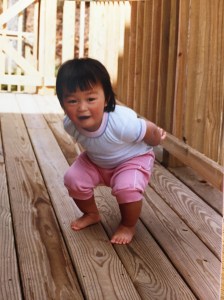
When I was old enough to understand basic commands, my father trained me to perform a Mexican hat dance on cue. Another bizarre trick had me headbanging when he said “DONG!” This continued until I was around age three or four; I discovered humiliation and refused to put on any more shows for the video camera or family friends.

It was then that I, their little Korean refugee, was no longer considered “fun.”

mexican hat dance
Position assumed, followed by tap-dancing around an imaginary sombrero. #unfortunateimplications

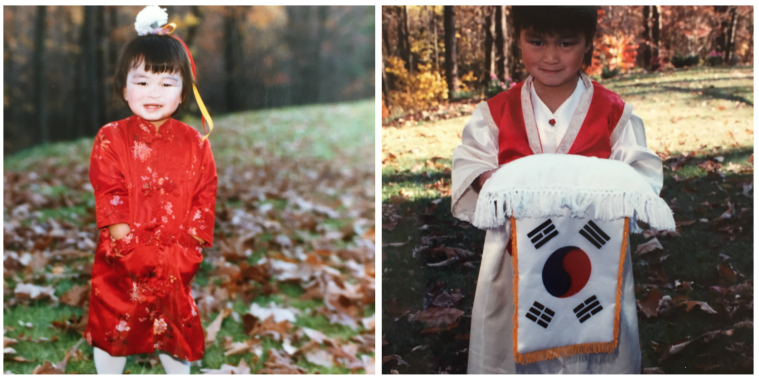
Halloween was their chance to shine. Like a doll, mom forced me into a gifted Chinese dress (I’m Korean), caked on white facepaint, and squeezed my chubby toddler feet into pointy rubber Chinese shoes. The following year, I wore a hanbok; instead of a trick-or-treat bag, I carried a pillow with a South Korean flag pinned to it.

collage
#cultureequalscostume

As I struggled toward adulthood, I remained their perpetual Korean orphan, an amusing participant for their parlor games. Through growth and distance, I bastardized their original presumption that Koreans were “quiet, trouble-free, responsible and achieving people”; in fact, I was regularly reminded that if I were still in my home country, I wouldn’t make it because I’m too loud, too demanding, too me.

The adoptee is caught between, spoken for, treated as a purpose, or a context, as a way to improve the adoptive parent or agency, as something to be learned from or ignored, as less an individual with her own agency and more a contribution to the agency of someone else. –Matthew Salesses

In the above quote, Salesses pointedly offers a nuanced view of an adoptee’s self-defined purpose. I agree with him, and would argue that it’s partially because the “general public still broadly understands Korean and other Asian adoptees as child foundlings who are lucky to have the opportunity to become American.” When transracial adoptees grow up, we no longer wish to be marionettes for families built on misconceptions, even though some of those illusions were enforced by our placing agencies. In fact, many adult Korean adoptees “describe a diminishing relationship to family during and after the expansion of their Korean adoptee identities.” It’s no surprise they’re staging a quiet rebellion.

I discuss this subject in my book, looking at how innocent-seeming heritage appreciation and assimilation attempts by White parents can quickly transform into racial microaggressions, or in other cases, outright aggression. South Korea’s recent apologies to adoptees haven’t helped; instead, they remind the public that we’re “pathetic and pitiable orphan[s] and…lucky transnational émigré.”

Though all this leads to tangled identity crises that I hope to unscramble, I don’t believe it was totally malicious. My parents did the best they could, espousing the then-celebrated and now-derided 1980’s colorblind theory, a societal failing that I’m working on dissembling. I seek to portray them – and other well-meaning White adoptive parents – as victims of misaimed marketing, cultural norms, and – in my parents’ cases – insular upbringings.

Like this? Want more? So do I! Find out about my upcoming ventures on my Patreon page!